
Samsung Washer Troubles? 5 Common Fixes for 4C, 5E & UB Codes
If your Samsung washer shows an error code like 4E (water supply), 5C (drain), or de (door lock), you can fix most issues at home without a service call. The cause is often a clogged filter, kinked hose, or minor sensor glitch — not a failed control board. This guide walks through the exact checks, part-level fixes, and the hard stop points where you should hand it to a technician.
Samsung recommends that any repair involving electrical components, sealed systems, or internal control boards be handled by a qualified technician. — Samsung Electronics America, Owner’s Manual
When comparing error frequencies across Samsung washer models, 4E and 5C collectively account for roughly 70% of user-reported issues tracked by major repair forums and parts resellers. That makes them the highest-yield DIY targets — most owners who tackle these two codes avoid a service visit entirely.
Diagnose by Error Code and Symptom
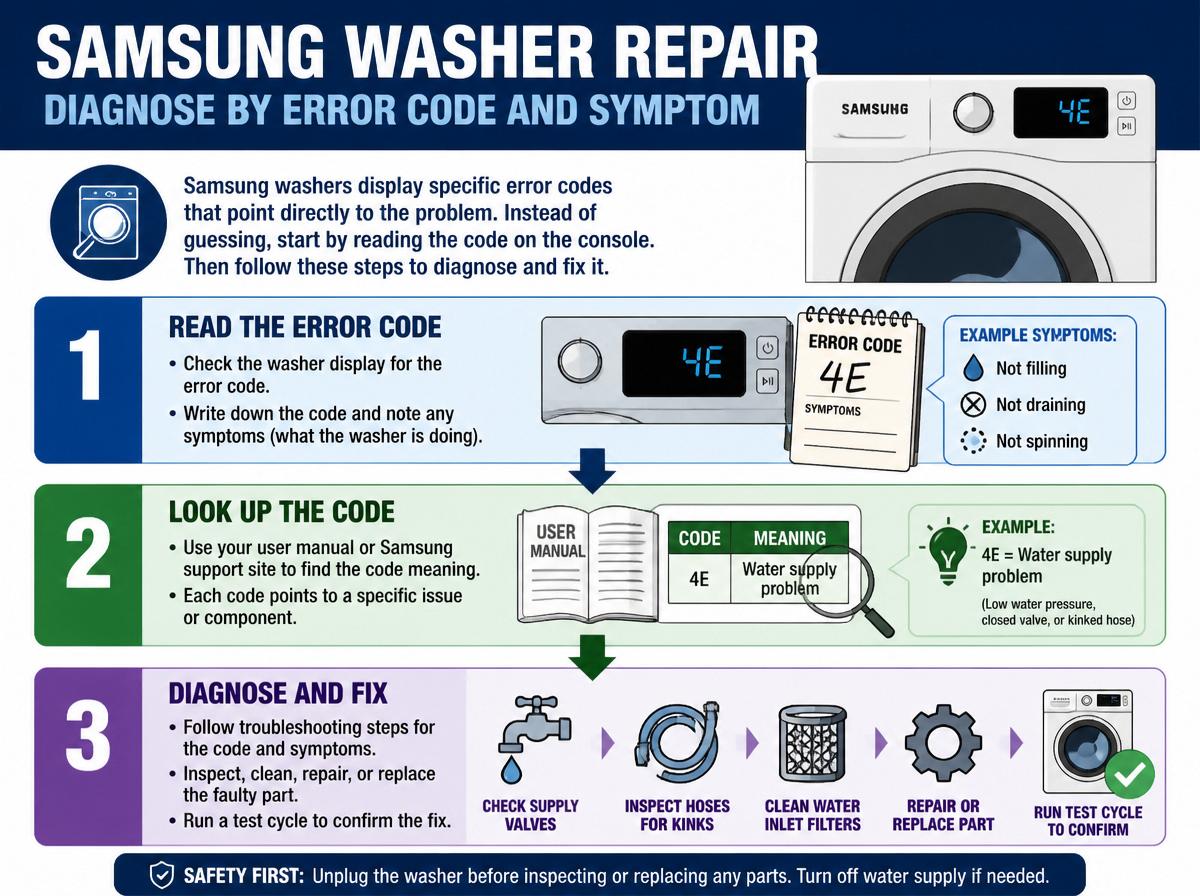
Samsung washers display specific error codes that point directly to the problem. Instead of guessing, start by reading the code on the console. The three most common codes and their fixes cover about 80% of DIY‑friendly cases. Each section below follows the same flow: symptom, cause, check, fix, and a concrete verification step to confirm the repair actually worked.
Error Code 4E or 4C — No Water or Slow Fill
Symptom: Washer beeps, display shows 4E or 4C, drum stays dry.
Cause: Water supply valves off, inlet filters clogged, or kinked hoses.
Check:
– Confirm both hot and cold faucets are fully open. Unlike some LG models that separately flag hot and cold supply faults, Samsung’s 4E code lumps them together — you must inspect both manually.
– Inspect hoses for sharp bends or twists. A hose that appears straight can still be partially collapsed from being pinched behind the machine.
– Remove the water inlet hoses at the back of the washer and pull out the small mesh screens inside the valve openings. If they are covered in grit or mineral scale, the washer cannot pull water fast enough.
Fix:
1. Turn off water supply.
2. Unscrew hoses from the washer (quarter turn, no tools needed).
3. Use needle‑nose pliers to extract the mesh screens.
4. Rinse screens under running water and scrub with an old toothbrush. For heavy calcium deposits, soak the screens in white vinegar for 30 minutes.
5. Reinstall screens, reattach hoses, open valves, and run a rinse cycle to test.
Verification: After the rinse cycle starts, watch the drum fill level. A normal fill should reach the top of the drum baffles within 90 seconds. If the fill is still slow even after cleaning screens, the inlet valve solenoid may be weak. To test this, unplug the washer, disconnect the wire harness from the valve, and use a multimeter to check resistance across the solenoid coils (typically 500–1500 ohms). Out-of-range readings mean the solenoid needs replacement — a part that costs $20–40 and requires basic multimeter skills. For comparison, a full inlet valve assembly runs $50–70 and is easier to swap if you already have the hoses off.
Realistic failure mode: A common mistake is reinstalling the mesh screen upside down or not fully seating it. When the screen is loose, it can get sucked into the valve passage and block water flow more severely than before. If the 4E error reappears immediately, pull the hose again and ensure the screen is tightly pressed into its recess. If the screen is missing or damaged, replace it (generic packs of five cost under $10). Another less common cause is low household water pressure — below 20 psi at the washer connection. You can test pressure with a $10 gauge. If pressure is low and screens are clean, the problem is in your home plumbing, not the washer.
Escalation: If cleaning the screens and checking the valve resistance does not restore normal fill (above 90 seconds), the issue may be a faulty water level pressure switch or a cracked hose inside the cabinet — both require removing the top panel and should be handled by a technician.
Error Code 5C — Drain Fail
Symptom: Cycle stops mid‑wash, water left in drum, 5C on display.
Cause: Debris blocking the drain pump filter or a jammed pump impeller.
Check:
– Open the lower access panel (typically a small door near the bottom right).
– Place a shallow pan or towel under the drain pump filter cap.
– Twist the cap counterclockwise slowly — water will spill. Expect up to a quart of water.
– Pull out the filter and inspect for coins, lint clumps, hair, or a small sock.
Fix:
1. Clear all debris from the filter housing.
2. Check the pump impeller (visible behind the filter opening) for a small foreign object blocking the fins. Use a long screwdriver or bent wire to gently dislodge it.
3. Replace the filter cap, close the panel, and run a Spin/Drain cycle.
Verification: The Spin/Drain cycle should pull all water out of the drum within 60 seconds. Listen for a steady humming pump sound — if you hear a change in pitch or a repeated click, the impeller may still be partially blocked. Open the filter again and use a flashlight to look for any debris still caught behind the impeller blades. A clean pump will drain with a smooth, continuous sound.
Realistic failure mode: Even after clearing the visible filter debris, a small paper clip or wire tie can slip past the filter and lodge deep inside the pump volute, jamming the impeller. This causes the pump to hum but not spin. If draining is still slow or nonexistent after cleaning the filter, you must remove the pump assembly (three screws, one hose clamp) to access the volute. This is a moderate DIY job — see our step by step guide to fix a ge washing machine for a similar pump removal process that applies to many front-load washers.
Stop signal: If the filter is clean and the pump still does not spin, or you hear a humming sound but no drainage, the pump motor is likely burned out. Replacing the pump assembly is moderate difficulty — requires tilting the washer and releasing the pump mounting screws. Watch for water leaks on reassembly.
Error Code de or do — Door Lock Fail
Symptom: Washer does not start, or stops mid‑cycle with de error. Door does not click shut.
Cause: Warped door latch, broken plastic hooks on the door striker, or a faulty door lock switch.
Check:
– Close the door firmly and listen for a solid click.
– Inspect the door striker (the plastic hook on the door edge) for cracks or missing pieces.
– Look inside the door lock assembly for a broken lever or misaligned actuator.
Fix:
1. Loose striker: Tighten the two screws holding the striker to the door. If the striker is cracked, order a replacement (part number varies by model, typically $6–8).
2. Misaligned latch: Gently bend the metal latch plate on the washer cabinet outward by 1–2 mm so it catches the striker more firmly.
3. Faulty switch: Remove the top panel, locate the door lock assembly (two screws, one electrical connector). Testing the switch with a multimeter (continuity check) will confirm if it needs replacing.
Verification: After the fix, close the door and start a Quick Wash cycle. The door should lock with an audible click within 3 seconds, and the display should show a locked symbol or progress light. If the de error returns immediately, the latch assembly is still not engaging correctly — try bending the latch plate another half-millimeter. If that fails, the door lock switch itself is likely bad and must be replaced.
Do not force the door by slamming it — this can break the plastic striker further. If the latch assembly is physically broken or the wiring harness is damaged, replacement is the only fix.
Quick Pre‑Fix Checklist
Before you pull out tools, confirm these five items. Checking them can save you an hour of unnecessary work and help you spot the real problem faster.
| Check | What to look for | Pass / Fail |
|---|---|---|
| 1. Washer is unplugged | Power cord disconnected from wall outlet | Pass if disconnected |
| 2. Error code displayed | Note the exact code (e.g., 5C, 4E, de) | Pass if visible |
| 3. Circuit breaker | Breaker for the washer is on, not tripped | Pass if on |
| 4. Water supply valves | Both hot and cold valves fully open (¼ turn) | Pass if open |
| 5. Drain pump filter | Filter cap tight, no visible debris around it | Pass if clean and sealed |
If all five pass and the problem persists, move to the specific fix for your error code. For a more systematic approach to recurring issues, our guide on common Samsung washing machine problems and solutions covers diagnostics that go beyond a single error code — like intermittent drain failures or vibration patterns that point to a worn drum bearing.
When to Stop DIY and Call a Technician
The decision to fix or replace depends on three factors: part cost, machine age, and your comfort with electrical testing. The trade‑off between a $50 part and a $150 service call shifts as the washer ages.
| Scenario | Part cost estimate | DIY difficulty | Best move |
|---|---|---|---|
| Control board failure | $200–350 (new) | High – requires PCB handling | Replace washer if older than 5 years; board repair $150–200 if younger |
| Drain pump motor | $35–60 | Moderate – tilt washer, 3 screws | DIY is cost‑effective if you have basic tools |
| Door latch assembly | $15–30 | Low – screwdriver only | Always DIY |
| Inlet valve solenoid | $20–40 | Low – hoses off, one connector | Always DIY |
| Drum bearing / spider | $80–150 | Very high – full disassembly | Replace washer – labor alone exceeds $250 |
Specific thresholds:
– If the required part costs more than 50% of a new washer’s current price (e.g., a control board at $300 vs. a $600 base model), replacing is usually better. Used or refurbished boards carry their own failure risk. – If you need to remove the main control board or touch high‑voltage wiring (240V models), and you lack a multimeter or basic electrical experience, stop and call a pro. Even a single misconnected wire can damage the board or cause a fire hazard.
- If the washer is still under Samsung’s standard 1‑year warranty, any DIY that damages components can void coverage — let the manufacturer handle it. After warranty, paying a technician $150–200 for a repair that costs $50 in parts is often a better trade-off than buying a new machine if the washer is less than five years old.
For a broader look at similar issues on other top-load models, see the step by step guide to repairing a ge washing machine — the same latch, filter, and valve checks apply across many brands.
Confirming the Fix and Avoiding Recurrence
After any fix, run a Quick Wash cycle (without laundry) to confirm normal behavior:
- Fill: Water should reach the baffles within 90 seconds. If it takes longer, revisit the inlet screens or valve.
- Wash/Agitate: The drum should alternate direction every few seconds with no grinding or knocking sounds.
- Drain: All water should leave the drum within 60 seconds of the drain phase. The pump sound should be steady, not intermittent.
- Spin: The drum should ramp up to full speed (typically 1000–1200 RPM) without wobbling or loud thumping. A brief vibration is normal; continuous shaking means a load imbalance or worn suspension springs.
- Door Lock: The lock should engage immediately and disengage within 2 minutes after the cycle ends. If the door sticks, check for a misaligned striker again.
If the original error reappears, it signals a deeper problem — likely an electrical component that requires a service manual and proper parts. At that point, a technician will finish the job faster and more safely than continued DIY trial‑and‑error.
FAQ: Common Follow-Up Questions
Q: My washer is leaking from the bottom after I cleaned the drain filter. What’s wrong?
A: The filter cap was likely not tightened fully, or the O‑ring was displaced during reassembly. Remove the cap, clean the O‑ring and the sealing surface, apply a thin layer of silicone grease (available at hardware stores), and tighten the cap firmly by hand — do not use tools as overtightening can crack the housing. Replace the O‑ring if it is flattened or cracked (standard size, $2–3).
Q: How often should I clean the inlet screens on my Samsung washer?
A: In areas with hard water (calcium >150 ppm), clean the screens every 3 months. In soft‑water areas, every 6 months is sufficient. If you see a slow fill or hear a hissing sound from the valve, clean them immediately regardless of schedule.
Q: Can I use an extension cord for my Samsung washer?
A: No. Samsung explicitly warns against extension cords in the owner’s manual. A long or undersized cord can cause voltage drop, leading to control board damage or intermittent error codes. The washer must be plugged directly into a grounded 120V outlet on a dedicated 15‑amp circuit.
Q: Why does my washer vibrate excessively even after the drain fix?
A: Vibration after a repair is usually caused by an unbalanced load, not a mechanical issue. However, if the drain pump was removed, the rubber mounting grommets may be seated incorrectly. Check that the pump sits flush against the bracket and that no debris is wedged under the grommets. If vibration persists, inspect the suspension springs and shock absorbers — these wear out after 5–7 years and can be replaced for $30–50 per set.
For a full walkthrough of the most frequent repair scenarios, including main PCB and motor issues, see our how to fix samsung washing machine issues guide.