
Whirlpool Washer Troubleshooting: Common Problems and Complete Fix Guide
If your Whirlpool washer stops mid‑cycle, won’t spin, or displays an error code, the most common culprits are a failed lid lock assembly, a blocked drain pump, or a drive belt that has slipped or snapped. This guide walks you through the earliest checks, the likely causes, and the step‑by‑step fixes you can safely do at home—and tells you exactly when to call a repairman.
Quick Triage Checklist: 5 Checks Before You Open the Cabinet
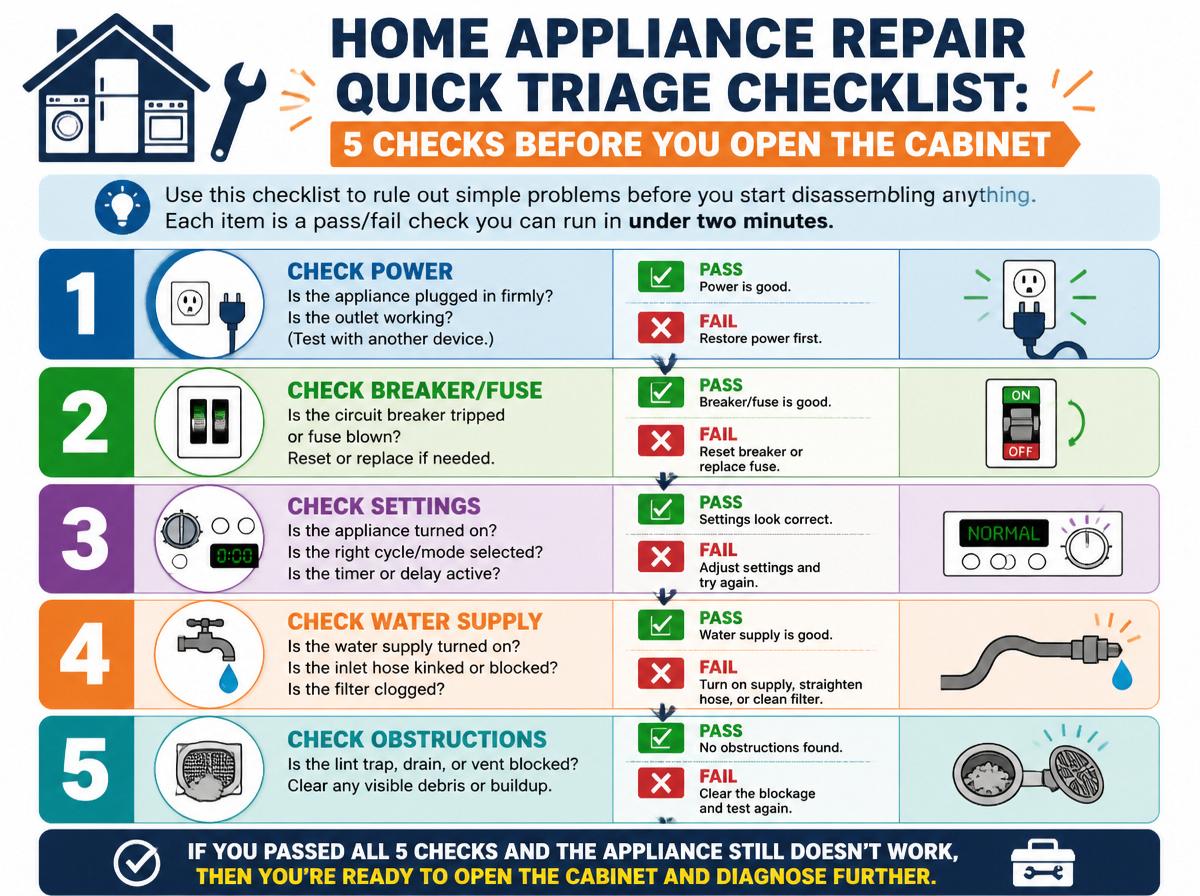
Use this checklist to rule out simple problems before you start disassembling anything. Each item is a pass/fail check you can run in under two minutes.
- Power supply – Is the washer plugged in securely? Does the outlet have power (test with a lamp or multimeter)? Pass = lights come on, display works. Fail = reset GFCI or try another outlet.
- Error code on the display – Note any code (e.g., F0E5, F7E1). Pass = no code, machine runs. Fail = consult the error code section below for that specific code.
- Lid lock (top‑load) or door lock (front‑load) – Press Start and listen for a click within 5 seconds. Pass = audible lock click. Fail = no click or click but no latch – the lock assembly is likely bad.
- Water supply – Are both hot and cold faucets fully open? Check hoses for kinks. Pass = water flows when you open the tap. Fail = restricted supply – straighten hoses, open valves.
- Drain hose – Is the hose end lower than the washer’s drain pump, or is it clogged? Pass = water drains within 5 minutes of cycle end. Fail = block the hose or pump inlet.
Error Code Diagnostics: What Each Code Means and How to Fix It
Whirlpool washers use a handful of common error codes. Below are the ones you are most likely to encounter, with a direct symptom‑cause‑check‑fix path for each. For a broader overview of model‑specific codes, see our guide on common issues in whirlpool washing machines and how to fix them.
F0E5 – Drive System Problem
- Symptom: Washer stops spinning, displays F0E5 after a spin attempt.
- Cause: Failed drive motor, bad motor control board, or loose wiring harness.
- Check: Unplug the washer, remove the rear panel, and inspect the motor connector for burnt pins or corrosion. Test motor continuity with a multimeter (should be 5–20 ohms across windings).
- Fix: If the connector is damaged, replace the wiring harness. If motor continuity is out of range, replace the drive motor. Escalate if you get no continuity and the motor control board appears intact – the board itself may need replacement.
- Verification: After repair, run a Spin cycle with an empty drum. The washer should accelerate smoothly and reach a steady spin speed without throwing the code again.
F0E6 – Communication Error
- Symptom: Control panel lights flash, cycle does not start, code appears.
- Cause: Loose ribbon cable between the main control board and the user interface board.
- Check: Unplug the washer, open the console, and reseat both ribbon cable connectors.
- Fix: If reseating doesn’t clear the code, inspect the cable for cuts. Replace the ribbon cable if damaged. Stop if you see burn marks on the control board – that points to a board‑level failure.
F7E1 – Motor Stall
- Symptom: Drum won’t turn, loud humming, code appears after 30 seconds.
- Cause: Overloaded washer, seized drum bearings, or blocked pump impeller.
- Check: Open the door – is the drum free to rotate by hand? If not, remove the belt (see drive belt section) and spin the drum by hand to rule out bearing failure.
- Fix: If the drum spins freely without the belt, the fault is in the drive system. If the drum is seized, replace the bearings or tub assembly. Escalate if you see rust or water leaks around the bearing area.
Mechanical Problems: When the Washer Won’t Spin, Drain, or Agitate
These three symptoms cover the majority of non‑error‑code breakdowns. Follow the ordered steps for each.
No Spin
- Check for unbalanced load – Open the door, redistribute the laundry, and run a Drain & Spin cycle. If the drum spins, the load was simply out of balance.
- Inspect the lid switch (top‑load) – On Whirlpool top‑loaders, the lid switch must be depressed for the spin to engage. Push the switch manually with a screwdriver – if the washer spins, the switch actuator is broken. Replace the lid switch assembly.
- Test the drive belt – Remove the rear panel. If the belt is loose, cracked, or missing, replace it. See the drive belt section below for a specific part number and replacement steps.
- Verify spin repair – After any fix, run a Spin cycle with a small load (2-3 towels). The drum should accelerate without wobbling and reach full speed in under 10 seconds. If it stops short, recheck the belt tension or lid switch alignment.
No Drain
- Check the drain hose – Is the hose end blocked or kinked? Straighten it. Ensure the hose is not inserted more than 4–5 inches into the standpipe – deeper insertion can cause siphoning and poor drain performance.
- Clean the drain pump filter – On front‑load Whirlpool washers, the filter is behind the lower kickplate. Open it (place a towel under), remove debris like coins, lint, and hair. Reinstall.
- Test the drain pump – If the filter is clean and the hose is clear, the pump may be dead. Use a multimeter to check for continuity across the pump terminals (typically 50–200 ohms). No continuity = replace the pump.
- Check for foreign objects in the pump housing – If the pump has continuity but still won’t drain, a stuck item (e.g., a sock or small piece of plastic) may be jamming the impeller. Remove the pump and inspect the housing. Escalate if the pump housing is cracked or the impeller blades are broken – the entire pump assembly must be replaced.
- Verify drain repair – Pour a gallon of water into the drum and run a Drain cycle. Water should empty in under 2 minutes. If it drains slowly, a partial blockage remains inside the pump housing or the hose has a low spot that holds water.
No Agitation (Top‑Load)
- Check for a stuck agitator – Lift the agitator straight up. If it comes off easily, it was not seated correctly. Push it back down firmly.
- Inspect the drive coupler – On older top‑load models, the plastic drive coupler (between motor and transmission) can strip. Remove the rear panel and look for broken plastic tabs. Replace the coupler if needed.
- Test the transmission – If the motor runs but the agitator barely moves, the transmission is likely failing. Escalate – transmission replacement is a major repair that often exceeds the washer’s value. At this point, compare the repair cost (typically $250–$400 for parts and labor) against a new budget washer ($400–$600). If the washer is over 7 years old, replacement is usually the better decision.
The Lid Lock Failure Path: Fixes for Top‑Load Models
The lid lock is the single most common failure point on Whirlpool top‑load washers. The fix depends on exactly how it fails. For a deeper cover this specific issue, refer to our how to fix whirlpool washing machine lid lock guide.
- Symptom: No click when you press Start; washer won’t begin filling.
- Cause: The lock assembly is electrically dead.
- Check: Unplug the washer, remove the lid lock (two screws under the top panel), and test the micro‑switch inside with a multimeter. If no continuity when the plunger is pressed, replace the lock assembly.
- Symptom: Click heard but lid does not latch; washer stops mid‑cycle with an error.
- Cause: The plastic latch mechanism is broken or jammed.
- Check: Visually inspect the latch hook for cracks. Manually push the hook into the locked position – if it doesn’t stay, the internal spring is broken.
- Fix: Replace the lock assembly. Decision criterion: If you hear a click but the washer starts filling (even without the lid latched), the issue is likely the latch hook, not the entire lock – you can buy a replacement hook separately for some models. This saves about $15–$25 compared to a full lock assembly.
- Verification: After replacing the lock, close the lid and press Start. You should hear a distinct click within 2 seconds, and the cycle should begin filling. If it still fails, double‑check that the wiring connector is fully seated.
Stop/Red flag: If you smell burning plastic or see melted wires near the lock connector, do not attempt further repair – the control board may have a short. Unplug the washer and call a professional.
When to Replace the Drive Belt
The W11239857 W10808317 W10006384 Washer Drive Belt for Whirlpool, for Maytag, for Amana Top Load Clothes Washing Machine is a direct replacement for several Whirlpool, Maytag, and Amana top‑load models. Use it when you confirm:
- The belt is loose, cracked, or completely missing.
- The drum spins freely by hand but the motor runs without moving the drum.
- The washer makes a high‑pitched squealing or rubbing sound during a spin cycle.
Replacement steps (in brief): Unplug the washer, remove the rear panel, slip the old belt off the motor pulley and drum pulley, loop the new belt around the drum pulley first, then stretch it over the motor pulley. Rotate the drum to seat the belt. Re‑install the panel and run a test cycle.
Verification: With an empty drum, run a Spin cycle. The belt should not slip – listen for any chirping or squealing. After 30 seconds of spinning, stop the machine and check the belt tension manually; it should have about ½ inch of deflection when pressed firmly mid‑span between the pulleys. If the belt feels too loose, the tensioner may need adjustment or replacement. If the belt is too tight, the motor bearings may overheat.
Always disconnect power before starting any repair. As noted in Whirlpool’s technical documentation, failure to do so can cause electric shock or damage to the control board.
Cost vs. Value: When to Stop Troubleshooting
Not every problem is worth fixing yourself, especially if the washer is older or the repair cost approaches the price of a new machine. Here’s a quick decision framework based on the likely cause and the washer’s age:
- Lid switch or drive belt (under $30 part) – Worth fixing on any machine regardless of age; these are simple jobs that take under 30 minutes.
- Drain pump or drive motor ($50–$150 part) – Worth fixing if the washer is less than 8 years old. On older units, factor in the risk of other components failing soon.
- Transmission or control board ($150–$300 part plus labor) – Only worth fixing on high‑end Whirlpool models (e.g., Cabrio or Duet) that are less than 5 years old. For budget models over 5 years, replacement is more cost‑effective.
- Tub or bearing failure (over $200 in parts, significant disassembly) – Almost never worth repairing on machines over 6 years old; the labor alone often exceeds $300.
For a full comparison of common breakdown patterns and their repair feasibility, check our guide on common whirlpool washing machine problems.
Q&A: Three Common Whirlpool Washer Questions
Why is my Whirlpool washer not spinning but it drains?
The most likely causes are an unbalanced load, a faulty lid switch, or a broken drive belt. Start with the no‑spin steps above – redistribute the load, then check the lid switch. If the switch tests good, inspect the belt.
How do I reset my Whirlpool washer?
Unplug the washer (or flip the circuit breaker) for at least five minutes. Plug it back in, open and close the lid three times within 12 seconds, then select a cycle. This clears most temporary control board errors.
What does error code F0E5 mean on a Whirlpool washer?
F0E5 indicates a drive system fault – usually a failed motor, a bad motor control board, or a corroded wiring harness. Follow the diagnostic steps for F0E5 above; if you are not comfortable testing electrical continuity, call a technician.