
How Long Do Appliances Last? Complete 2026 Lifespan Guide by Brand Tier
Most major home appliances last 9 to 15 years on average. But that number changes dramatically depending on brand tier. A budget dishwasher averages 6-9 years, while a premium Miele dishwasher is engineered for 15-20 years. This guide breaks down REAL lifespan data from NAHB, InterNACHI, Consumer Reports, and manufacturer specifications — organized by appliance type AND brand tier so you get the number that actually applies to your unit.
Average Appliance Lifespan: The National Averages
Before breaking down by brand tier, here are the all-brands national averages from the two most-cited industry sources:
| Appliance | NAHB Average | InterNACHI Range |
|---|---|---|
| Refrigerator (freestanding) | 13 years | 9 to 13 years |
| Refrigerator (built-in) | N/A | 15 to 25 years |
| Washing Machine | 10 years | 5 to 15 years |
| Dryer (gas or electric) | 13 years | 13 years |
| Dishwasher | 9 years | 9 years |
| Gas Range / Oven | 15 years | 10 to 18 years |
| Electric Range / Oven | 13 years | 13 to 15 years |
| Over-the-Range Microwave | 9 years | 9 years |
| Standalone Freezer | 11 years | 10 to 20 years |
| Garbage Disposal | 12 years | 12 years |
Sources: NAHB Study of Life Expectancy of Home Components (2021 revised edition); InterNACHI Standard Estimated Life Expectancy Chart (nachi.org/life-expectancy).
Important: These are population averages. Your actual appliance lifespan depends heavily on which brand tier you bought and how well you maintain it.
Lifespan by Brand Tier: The Budget / Mid / Premium Breakdown
This is where most lifespan articles stop — and where the real differences are. Lifespan varies 50-100% across brand tiers:
| Appliance | Budget Tier | Mid-Range Tier | Premium Tier |
|---|---|---|---|
| Refrigerator (freestanding) | 8 to 11 years | 11 to 15 years | 15 to 20 years |
| Refrigerator (built-in) | N/A | 12 to 15 years | 18 to 25 years |
| Washing Machine (front-load) | 7 to 10 years | 10 to 13 years | 15 to 20 years |
| Washing Machine (top-load) | 8 to 11 years | 11 to 14 years | 15 to 25 years |
| Dryer | 9 to 12 years | 12 to 15 years | 15 to 20 years |
| Dishwasher | 6 to 9 years | 9 to 12 years | 15 to 20 years |
| Gas Range / Oven | 10 to 14 years | 13 to 17 years | 20 to 25 years |
| Electric Range / Oven | 9 to 13 years | 12 to 16 years | 18 to 22 years |
| Over-the-Range Microwave | 5 to 8 years | 8 to 10 years | 10 to 14 years |
Brand Tier Reference:
– Budget: Amana, Hotpoint, entry-level GE and Frigidaire
– Mid-Range: Whirlpool, LG, Samsung, Bosch (standard), KitchenAid, GE Profile
– Premium: Sub-Zero, Wolf, Miele, Thermador, Viking, Gaggenau
Sources: NAHB averages cross-referenced with Consumer Reports reliability surveys (2022 and 2024), Miele 10,000-hour design specifications, Sub-Zero published warranty terms, and Yale Appliance 33,190 service call data.
Brand Reliability Rankings: 2026 Data from 33,190 Real Service Calls
Yale Appliance tracked every service call across Boston, Cape Cod, and Southern New Hampshire in 2026. The metric: first-year service rate (percentage of units sold that needed repair within year one). Lower is better:
| Rank | Brand | Service Rate | Best Category |
|---|---|---|---|
| 1 | Speed Queen | 3.7% | Top-load laundry |
| 2 | LG | 5.5% | Front-load laundry, dishwashers |
| 3 | Miele | 7.4% | Dishwashers (5.5%), laundry |
| 4 | Sharp | 7.5% | Microwave drawers |
| 5 | Gaggenau | 7.7% | Wall ovens, induction |
| 6 | Bosch Benchmark | 7.8% | Induction cooktops |
| 7 | GE Profile | 8.0% | Laundry, cooking |
| 8 | LG Studio | 8.2% | Wall ovens, laundry |
| 9 | Bosch | 8.7% | Dishwashers |
| 10 | Signature Kitchen Suite | 8.8% | Pro ranges, induction |
| 11 | GE Appliances | 9.2% | Broad coverage, strong service network |
Key Findings from Yale’s Data:
– Laundry is the most reliable category — front-load washers from LG, GE, and Miele lead
– French door refrigerators need the most service — ice makers routing through the warm fridge section is the #1 issue
– Professional ranges are second most service-prone — high-heat components and igniter failures are common
– Smart appliances fail more — JD Power 2025 study: Wi-Fi connected appliances have 87 problems per 100 units vs. 63 PP100 for non-connected
Maintaining Your Appliances to Maximize Lifespan
Data from Energy Star and NAHB shows that consistent maintenance extends appliance lifespan by 20-40%. The three highest-impact maintenance tasks:
-
Clean refrigerator condenser coils annually — Dirty coils force the compressor to work harder. This is the single biggest predictor of compressor lifespan. Takes 15 minutes.
-
Replace washing machine fill hoses every 5 years — A burst hose is the most common catastrophic washer failure. Stainless steel braided hoses last longer than rubber.
-
Clean dryer vents annually — Restricted airflow forces the motor and heating element to work harder, and accumulated lint is a fire risk.
Repair vs Replace: The 50% Rule
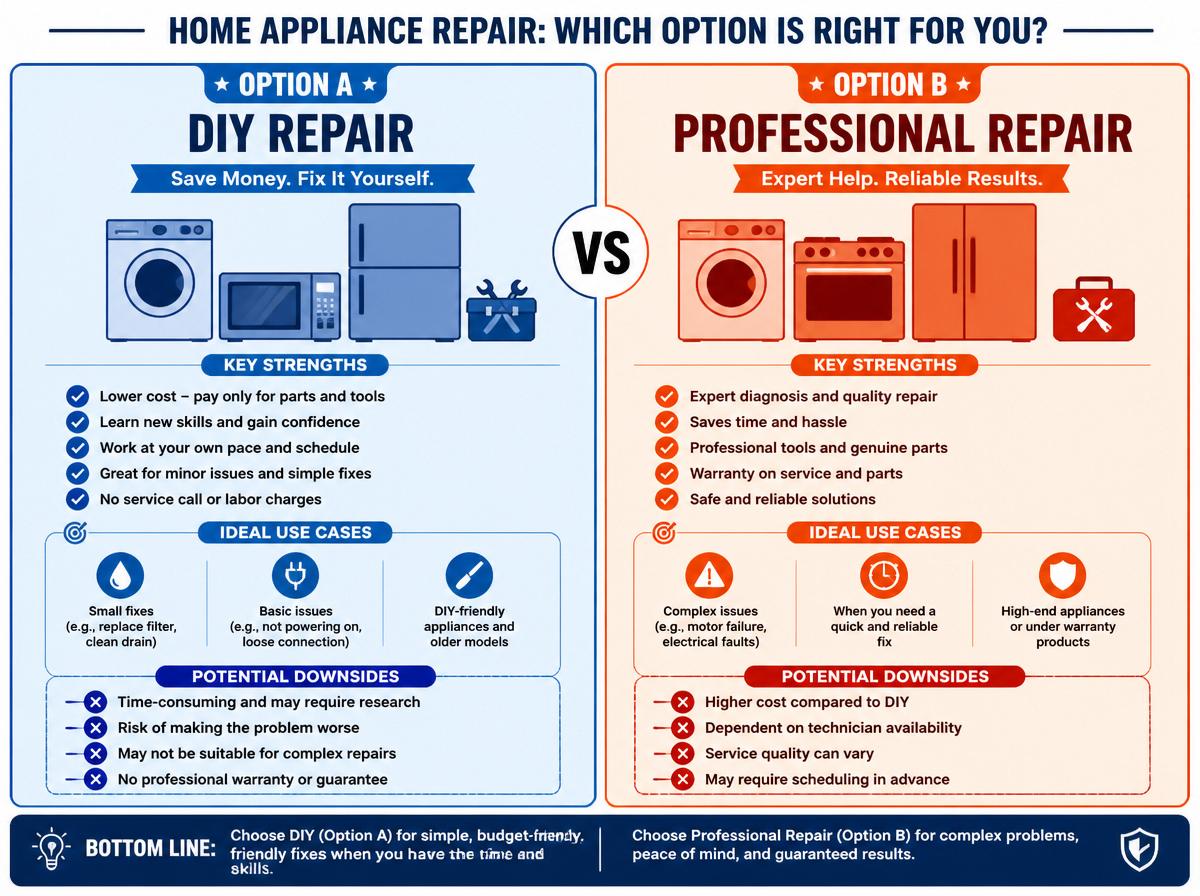
The industry standard decision framework: if the repair cost exceeds 50% of a new unit’s price, replace the appliance.
But lifespan data sharpens this rule further:
– A 9-year-old budget dishwasher is at the END of its statistical lifespan — replacement usually wins
– A 9-year-old Miele dishwasher is at only the HALFWAY point — repair almost always wins
– Tier matters more than age for premium appliances
Related Resource Guides:
Frequently Asked Questions
Do new appliances last as long as old ones?
No. Modern appliances have more complex electronics (control boards that replace mechanical timers) and thinner-gauge materials to meet energy standards. Budget-tier appliances have been most affected. Premium brands (Sub-Zero, Miele, Wolf) have largely resisted this trend and maintain 20-year lifespans.
Which appliance brand lasts the longest?
Speed Queen laundry machines and Sub-Zero refrigerators have the longest documented lifespans. Speed Queen builds washers and dryers in the same Wisconsin factory that supplies commercial laundromats, using heavy-duty components and mechanical controls instead of touchscreens. Sub-Zero refrigerators carry a 12-year sealed-system warranty — unmatched in the industry.
How do I know if my appliance is worth repairing?
Compare the repair estimate against your appliance’s expected remaining lifespan based on the brand tier table above. If your appliance is in the first two-thirds of its expected range and the repair costs less than 50% of replacement, repair it. If it’s in the final third, cross-check whether the NEXT likely failure will occur within 2 years.
Sources: NAHB Study of Life Expectancy of Home Components (2021); InterNACHI Life Expectancy Chart (nachi.org); Yale Appliance 2026 Reliability Data (33,190 service calls); JD Power 2025 U.S. Appliance Reliability & Service Study (12,755 households); Consumer Reports Appliance Reliability Surveys (2022, 2024); Energy Star Residential Appliances Program (energystar.gov).