
Most Reliable Appliance Brands 2026: Data-Backed Rankings from 33,190 Service Calls
Speed Queen, LG, and Miele are the three most reliable appliance brands in 2026, based on 33,190 real first-year service calls tracked by Yale Appliance across Boston, Cape Cod, and Southern New Hampshire. This isn’t based on reviews or lab tests — it’s based on which brands actually needed the fewest repairs in real homes.
The 2026 Reliability Rankings
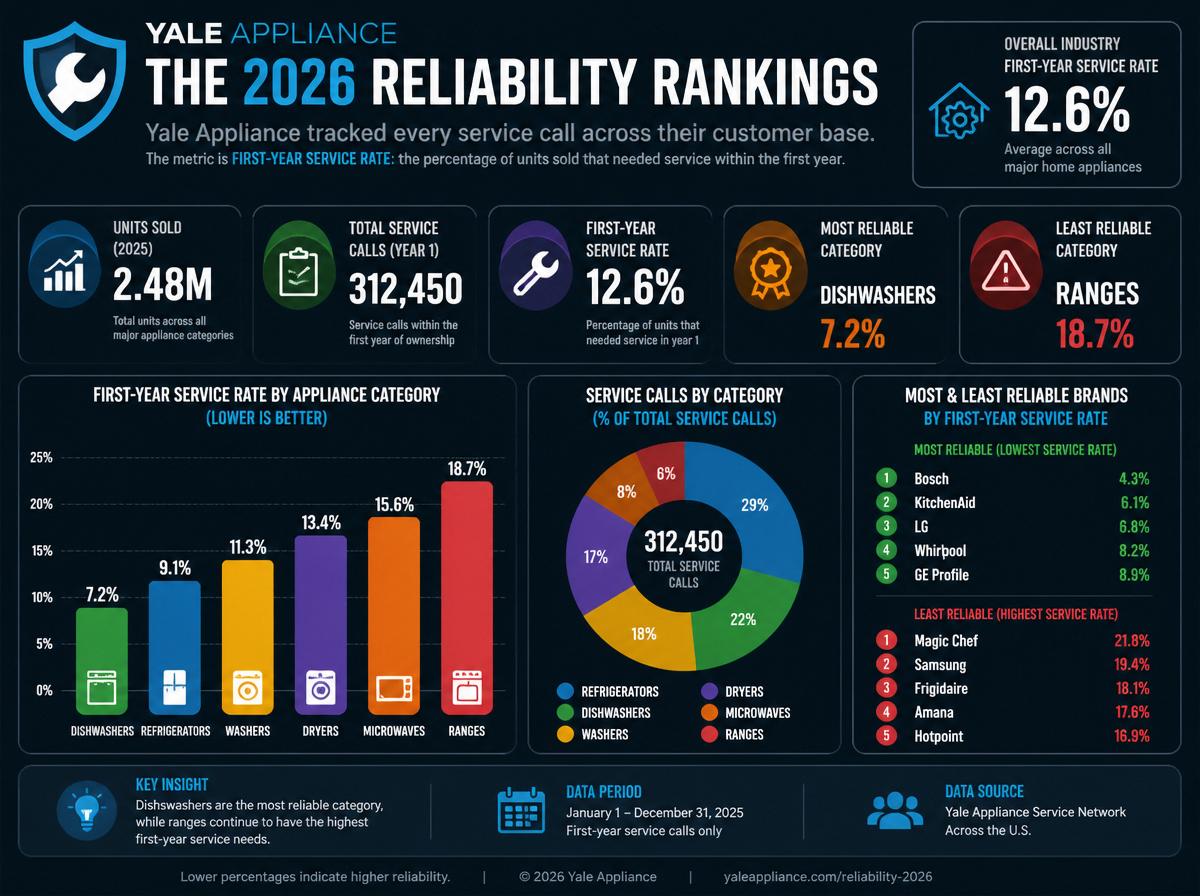
Yale Appliance tracked every service call across their customer base. The metric is first-year service rate: the percentage of units sold that needed repair within year one. Lower is better.
| Rank | Brand | Service Rate | Strongest Category |
|---|---|---|---|
| 1 | Speed Queen | 3.7% | Top-load laundry |
| 2 | LG | 5.5% | Front-load laundry, dishwashers |
| 3 | Miele | 7.4% | Dishwashers (5.5%), laundry |
| 4 | Sharp | 7.5% | Microwave drawers |
| 5 | Gaggenau | 7.7% | Wall ovens, induction cooktops |
| 6 | Bosch Benchmark | 7.8% | Induction cooktops |
| 7 | GE Profile | 8.0% | Laundry, cooking |
| 8 | LG Studio | 8.2% | Wall ovens, laundry |
| 9 | Bosch | 8.7% | Dishwashers |
| 10 | Signature Kitchen Suite | 8.8% | Pro ranges, induction |
| 11 | GE Appliances | 9.2% | Broad coverage, strong service network |
Source: Yale Appliance 2026 Annual Reliability Report. Based on 33,190 first-year service calls. Service rate = number of units serviced in year one ÷ number sold. Covers Greater Boston, Cape Cod, and Southern New Hampshire.
Brand-by-Brand Analysis
Speed Queen (3.7%) — Built Like a Laundromat Machine
Speed Queen builds washers and dryers in the same Wisconsin factory that supplies commercial laundromats across the country. No touchscreens. No Wi-Fi. Just heavy-duty mechanical controls and a solid steel transmission. At $1,400 for 2.7 cubic feet, they’re expensive and small — but they last. Their top-load washers use a tried-and-true agitator system that hasn’t fundamentally changed in decades. Nothing really changes with Speed Queen, and that’s exactly why people buy them.
Drawback: Smaller capacity, fewer features, lower energy efficiency than mainstream brands. Front-load models are less popular due to even smaller sizes and higher prices.
LG (5.5%) — Laundry Dominance
LG’s reliability is driven by their laundry category — front-load washers in particular have been among the lowest-serviced products for years. LG builds many of their own components: motors, compressors, and control boards come from their own factories. Their dishwashers are also strong performers. Refrigeration is more average — LG’s linear compressors fail about 1.1% of the time within five years, based on over 160,000 tracked service calls. That’s typical for the category but not exceptional.
Drawback: Service availability varies by region. Response times can be slow outside major metro areas.
Miele (7.4%) — Engineered for 20 Years
Miele explicitly designs its washing machines and dishwashers for 10,000 hours of operation — roughly 20 years of average household use. Their dishwasher service rate dropped from 10% to 5.5% this year. Miele is the premium benchmark: you pay more upfront, but the per-year cost is competitive with mid-range brands when you factor in the extended lifespan.
Drawback: Premium pricing. New tariffs have triggered a 15-20% price increase. Service availability varies by region.
GE Profile (8.0%) — Strong Mid-Premium Value
GE Profile offers advanced features without full luxury pricing. Their new 5.3 cubic foot washer with upgraded features has been solid. GE’s biggest advantage isn’t in the reliability numbers — it’s in their national service network. GE operates their own service organization, which matters enormously when something does break.
Drawback: Significant overlap with GE’s Café line. If you don’t need color options, Profile gives you most of the same functionality at a lower price.
Bosch (8.7%) — The Dishwasher Standard
Bosch is still the go-to for quiet, dependable dishwashers. Their core dishwasher reliability is why they remain one of the most recommended brands. Bosch has expanded their lower-priced 100 Series with more dishwasher and range models for affordability, but fewer innovations are happening at the high end.
Drawback: Refrigeration is a weaker category for Bosch. Refrigerators of any type are among the most serviced categories for every brand.
Which Appliance Types Are Most (and Least) Reliable?
Data from both Yale Appliance (33,190 calls) and JD Power (12,755 households) reveals clear patterns:
Most Reliable Categories:
– Washers and Dryers — Especially front-load laundry from LG, GE, and Miele. Many issues happen during installation, not use.
– Dishwashers — Fewer moving parts, simpler systems. Miele, Bosch, and KitchenAid lead.
Most Service-Prone Categories:
– French Door Refrigerators — Ice makers routing through the warm fridge section is the #1 issue across all brands
– Professional Ranges — More burners, more heat, more electronics = more failure points. Igniters are the most common repair.
Smart Appliances Fail More: JD Power 2025 data shows Wi-Fi connected appliances experience 87 problems per 100 units versus 63 PP100 for non-connected models. Active connected-feature users experience 92 PP100 — nearly 50% higher than standard appliances.
What This Means for Your Next Purchase
-
If reliability is everything: Buy Speed Queen for laundry. Accept the smaller capacity and higher price. The 3.7% service rate is unmatched.
-
If you want the best value for reliability: LG laundry + Bosch dishwasher. Both under 9% service rates, both competitively priced.
-
If you’re buying premium and plan to stay 15+ years: Miele or Sub-Zero. The upfront premium amortizes to a competitive annual cost when you factor in the 20-year lifespan.
-
Always check local service before you buy: A reliable brand with no local repair support is worse than an average brand with a technician 10 minutes away. Call a few local repair shops and ask about parts availability and typical response times for the brand you’re considering.
Related Resource Guides:
Frequently Asked Questions
Is Speed Queen really worth the premium price?
If you plan to stay in your home 10+ years, yes. At $1,400 for a washer that reliably lasts 15-20 years, the annual cost is $70-93. A $900 LG washer lasting 10-13 years costs $69-90 per year — nearly the same annual cost. The difference is you get better features and capacity with LG, but more durability with Speed Queen.
Do more expensive appliances last longer?
Yes, but with diminishing returns. Premium brands (Sub-Zero, Miele, Wolf) deliver 18-25 year lifespans versus 10-15 for mid-range. However, the effective annual cost often works out similar when you amortize the purchase price over the lifespan. A $10,000 Sub-Zero over 22 years costs $455/year. A $1,800 mid-range fridge over 11 years costs $164/year. You pay more per year for premium, but you get better build quality and fewer failures.
Why do smart appliances break more?
More components = more failure points. Wi-Fi modules, touchscreens, sensors, and control boards add complexity. The JD Power data (87 vs 63 PP100) quantifies what repair technicians have been saying for years: the simpler the machine, the fewer things that can break.
Sources: Yale Appliance 2026 Annual Reliability Report (33,190 first-year service calls); JD Power 2025 U.S. Appliance Reliability & Service Study (12,755 households); Consumer Reports Appliance Reliability Surveys (2022, 2024); NAHB Study of Life Expectancy of Home Components (2021).