LG Washer Problems? 7 Common Fixes for LE, OE & UE Error Codes
Most LG washer problems trace back to a small set of repeat offenders: a clogged drain filter, a failed door lock assembly, a worn drain pump, or an unbalanced load. The fastest diagnostic move is to note any error code on the display (OE, IE, dE, or UE) before resetting — that single step often cuts troubleshooting time in half. Start with a hard reset (unplug for 60 seconds, plug back in) to rule out a transient control glitch. If the error code returns, the symptom-specific flow below will help you isolate the fault.
Safety first: The US Consumer Product Safety Commission recommends unplugging the washer before any internal inspection or repair. Even switched-off machines can hold residual charge in the control board capacitors, so give it a full minute to discharge.
Error Codes and the Hard Reset
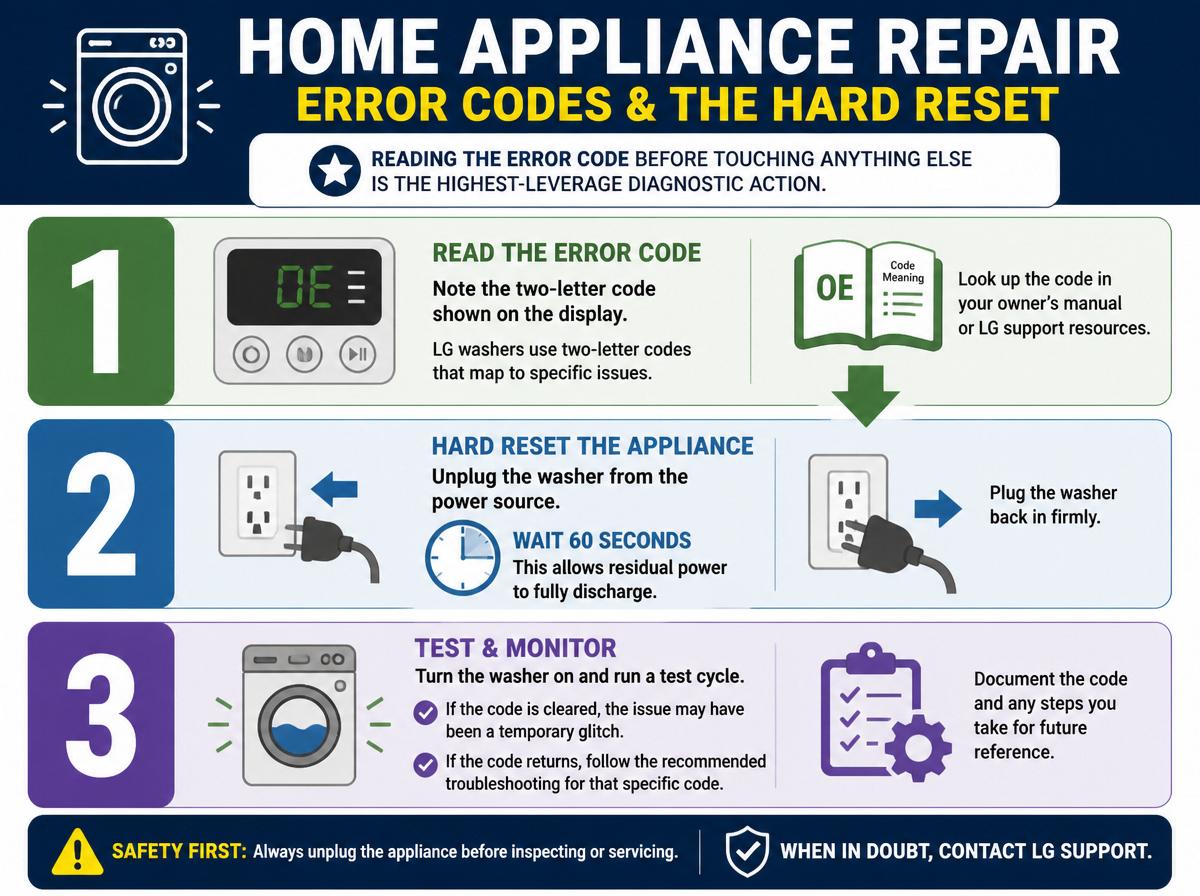
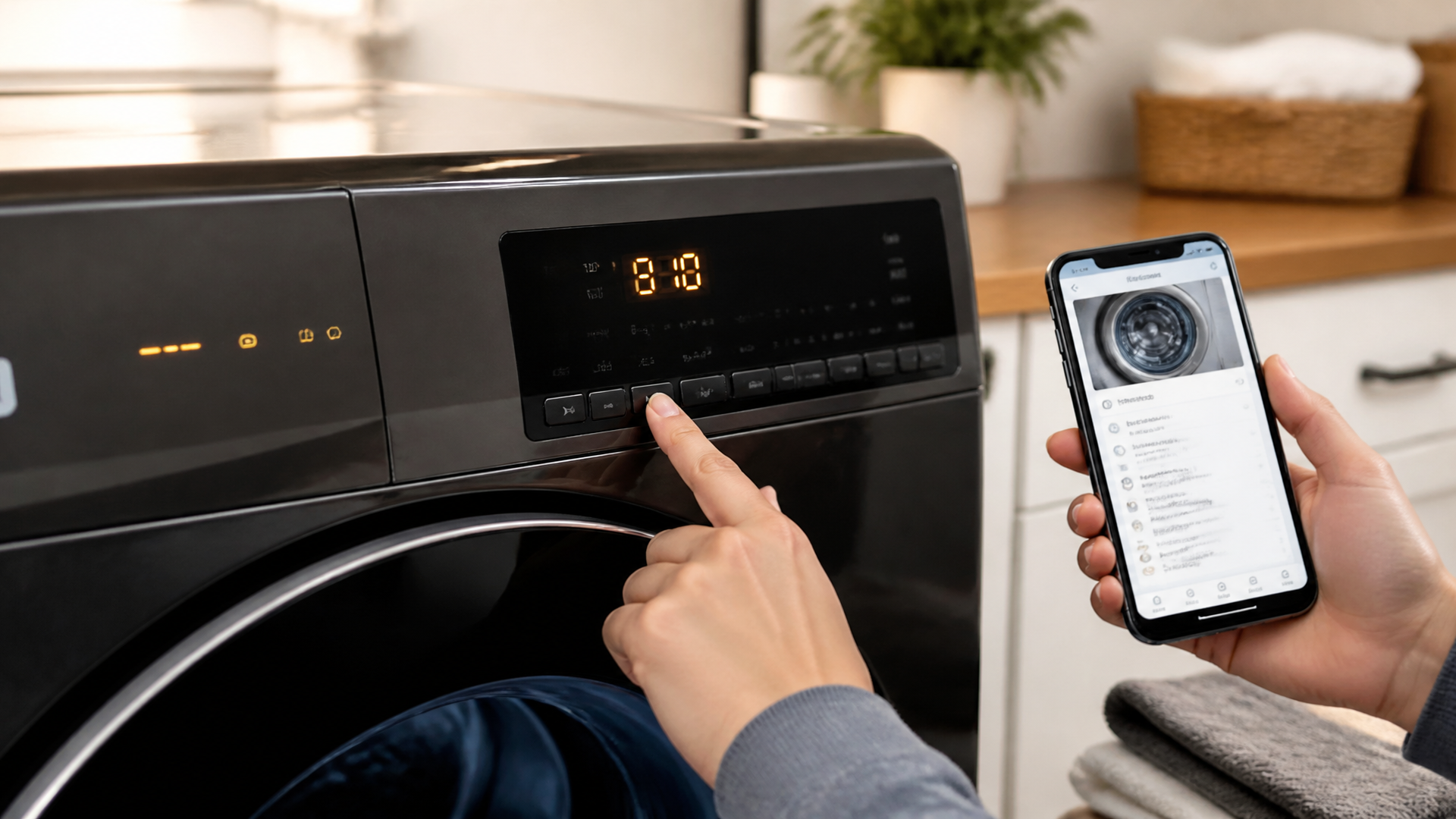
Reading the error code before touching anything else is the highest-leverage diagnostic action. LG washers use two-letter codes that map to specific subsystems, so writing down the code can save you from testing parts that are fine.
| Error Code | Meaning | First Action |
|---|---|---|
| OE | Drain failure – water not exiting | Clean drain pump filter; check drain hose |
| IE | No water or low water pressure | Verify water supply valves are open; check inlet screens |
| dE / dE1 / dE2 | Door lock error – door not closed or sensor fault | Inspect door strike alignment and magnetic plunger |
| UE | Unbalanced load – spin cycle can’t complete | Redistribute laundry; check leveling feet |
| LE | Motor or hall sensor fault | Requires multimeter continuity test or technician |
Once you have the code, perform a hard reset:
- Unplug the washer from the wall outlet.
- Wait 60 seconds minimum — longer if the display stays lit. Wait until it goes completely dark.
- Plug back in and run a Rinse + Spin cycle (no detergent).
If the error clears and doesn’t return, the root cause was likely a temporary controller glitch. If it reappears within the same cycle, move to the symptom-specific track below.
Symptom-by-Symptom Troubleshooting Flow
Each section follows a consistent format: Symptom → Likely Cause → Check → Fix. Follow the order to rule out simple problems before opening any panels.
No Drain or No Spin (Error Code OE or UE)
Likely causes: Clogged drain pump filter, blocked drain hose, failed drain pump motor, or a slipped/broken drive belt (top-load only).
Ordered checks:
- Clean the drain pump filter — The filter lives behind a small access door at the bottom-front of the washer. Place a shallow pan and towel under it, twist the cap counterclockwise, and pull out any lint, coins, or debris. Reinsert and tighten firmly. Try a drain-only cycle.
- Inspect the drain hose — Disconnect the hose from the standpipe or sink drain. Check for kinks, blockages, or a siphon lock (hose pushed too far into the standpipe). If water drains freely when the hose is lowered, the standpipe may be clogged.
- Test the drain pump for continuity — Unplug the washer, remove the pump access panel, and use a multimeter to check resistance across the pump terminals. A working pump typically reads 10–30 ohms. Open circuit (infinite resistance) means the pump needs replacement. A common replacement part for many front-loaders is the 【𝟮𝟬𝟮𝟲 𝗨𝗽𝗴𝗿𝗮𝗱𝗲𝗱】4681EA2001T Washer Drain Pump Motor, which includes a detachable filter housing that makes future cleaning easier.
- Check the drive belt (top-load only) — If the drum doesn’t spin at all during any cycle, the belt may be loose, glazed, or broken. Remove the rear service panel and inspect belt tension. A belt that deflects more than ½ inch under moderate finger pressure needs replacement.
Stop signal: If the pump has continuity, the filter is clean, the hose is clear, and the belt is intact, but the washer still won’t drain or spin, the main control board or wiring harness may be at fault. Escalate to a qualified technician at this point.
Door Won’t Lock (Error Code dE / dE1 / dE2)
Likely causes: Misaligned door strike, broken magnetic plunger, or faulty door latch switch assembly.
Ordered checks:
- Visually align the door — Close the door slowly and watch whether the metal strike (the loop on the door frame) enters the latch slot squarely. If it’s off by more than a millimeter, loosen the striker screws with a Phillips driver, adjust the position, and retighten.
- Inspect the magnetic plunger — On many LG front-loaders, a small magnetic plunger mounted on the door frame signals the latch that the door is closed. If it’s cracked, missing, or demagnetized, the machine will not lock. The 【𝟮𝟬𝟮𝟲 𝗨𝗽𝗴𝗿𝗮𝗱𝗲𝗱】 AGM73610701 Washer Magnetic Door Plunger is a direct-fit replacement that also holds the door slightly ajar when not in use, helping the door boot seal dry between cycles.
- Test latch switch continuity — With the washer unplugged, access the latch assembly (typically behind the top panel). Use a multimeter on the switch terminals. If the switch contacts don’t close when the door is fully shut, replace the latch assembly.
Escalation: If the plunger and latch test fine but dE still appears, the control board may have a failed door-lock relay. This is rarely a DIY replacement. For a broader view of door and latch faults, see our guide on common lg washing machine problems.
Leaks at the Front, Bottom, or Underneath
Likely causes: Worn door boot seal, loose drain pump filter cap, or cracked inlet hose.
Ordered checks:
- Front leak near the door — Inspect the rubber boot (door gasket) folded seam. Lift the lip and look for tears, holes, or trapped debris. If damaged, replace the gasket. Small pinholes can be temporarily sealed with appliance epoxy, but replacement is the permanent fix.
- Water pooling at the bottom-front — The drain pump filter cap may be loose, cross-threaded, or missing its O-ring. Remove, clean the O-ring or replace it, apply a thin layer of silicone grease, and tighten until snug (not over-tightened).
- Leak underneath the washer — Tip the washer back carefully (with a helper) and inspect the hoses connecting the water inlet valves and the drain pump. Tighten hose clamps; replace any hose with cracks or bulges.
Stop signal: If all hoses, gaskets, and seals appear intact but water still appears, the inner tub or bellows may be cracked — this requires full disassembly and is best handled by a technician.
Excessive Vibration or “Walk” (Error Code UE)
Likely causes: Uneven load distribution, unlevel feet, or shipping bolts left in place (on new machines).
Ordered checks:
- Redistribute or reduce the load — Large items like comforters or rugs can clump. Open the door, spread the laundry evenly around the drum, and run a Spin Only cycle.
- Level the washer — Place a bubble level on top of the machine. Adjust each leveling foot by turning clockwise to lower or counterclockwise to raise. Tighten the lock nuts when finished.
- Remove shipping bolts — If the washer is new, four transit bolts on the rear panel must be removed. LG machines will shake violently and may walk across the floor if these are left in.
Success check: After leveling, the washer should stay within 1 inch of its original position during a high-speed spin. If it still walks, the floor may be too flexible — a vibration-dampening mat can help. For spin-specific failures beyond vibration, the article on common issues in washing machine spin cycle repair covers belt, motor, and clutch diagnostics in more detail.
Preventive Maintenance Checklist
Run through these items every 3–6 months to catch developing problems early:
- [ ] Drain pump filter — Remove, rinse, and reinstall. Check for coins, lint clumps, or small objects.
- [ ] Door boot (gasket) fold — Lift the rubber lip and wipe away moisture, lint, and debris. Leave the door ajar between uses.
- [ ] Inlet hoses — Inspect for bulges, kinks, or leaks. Replace braided hoses every 5 years regardless of visible condition.
- [ ] Cleaning cycle — Run an empty cycle with an appliance cleaner or hot water and vinegar once a month to prevent biofilm buildup and odor.
- [ ] Leveling feet — Re-check after any floor changes, moving the machine, or after a heavy-load cycle that caused vibration.
Frequently Asked Questions
Q: Why does my LG washer keep showing OE after I already cleaned the filter?
A: The drain pump motor may be failing electrically. Test it with a multimeter for continuity (expected range: 10–30 ohms). If the meter reads infinite resistance (open circuit), the pump needs replacement. Also verify the drain hose isn’t pushed too far into the standpipe — that can create a siphon lock that mimics a pump failure.
Q: Can I replace the door boot gasket myself, or should I call a technician?
A: It’s doable at home but requires patience and the right tools (screwdriver set, spring clamp pliers, and a new gasket). The process involves removing the top panel, control panel, and door, then carefully seating the new gasket so the spring clamp engages evenly. If you’re not comfortable with that level of disassembly, a technician can complete the job in roughly one hour.
Q: How do I properly reset the control board on an LG washer?
A: Unplug the washer for 60 seconds, then plug it back in. For some models, pressing and holding the Start/Pause button for 5 seconds during the reboot will also clear stored errors. If the same error code returns immediately after the reset, the control board or a connected component (door lock, pump, sensor) has a persistent fault. For step-by-step guidance on board resets and deeper diagnostics, see our guide on how to fix lg washing machine problems.