
Bosch Dishwasher E24 Error Code: How to Diagnose and Fix
The Bosch E24 error code means the dishwasher has detected water in the base pan (the leak-sensor tray under the appliance) or a drainage problem that’s leaving standing water. Most of the time it’s a simple blockage or a misrouted hose, but it can also point to a failing drain pump or a leak that needs pro repair. This guide walks you through the exact checks in the right order so you don’t waste time or money on unnecessary parts.
What the E24 Code Actually Tells You
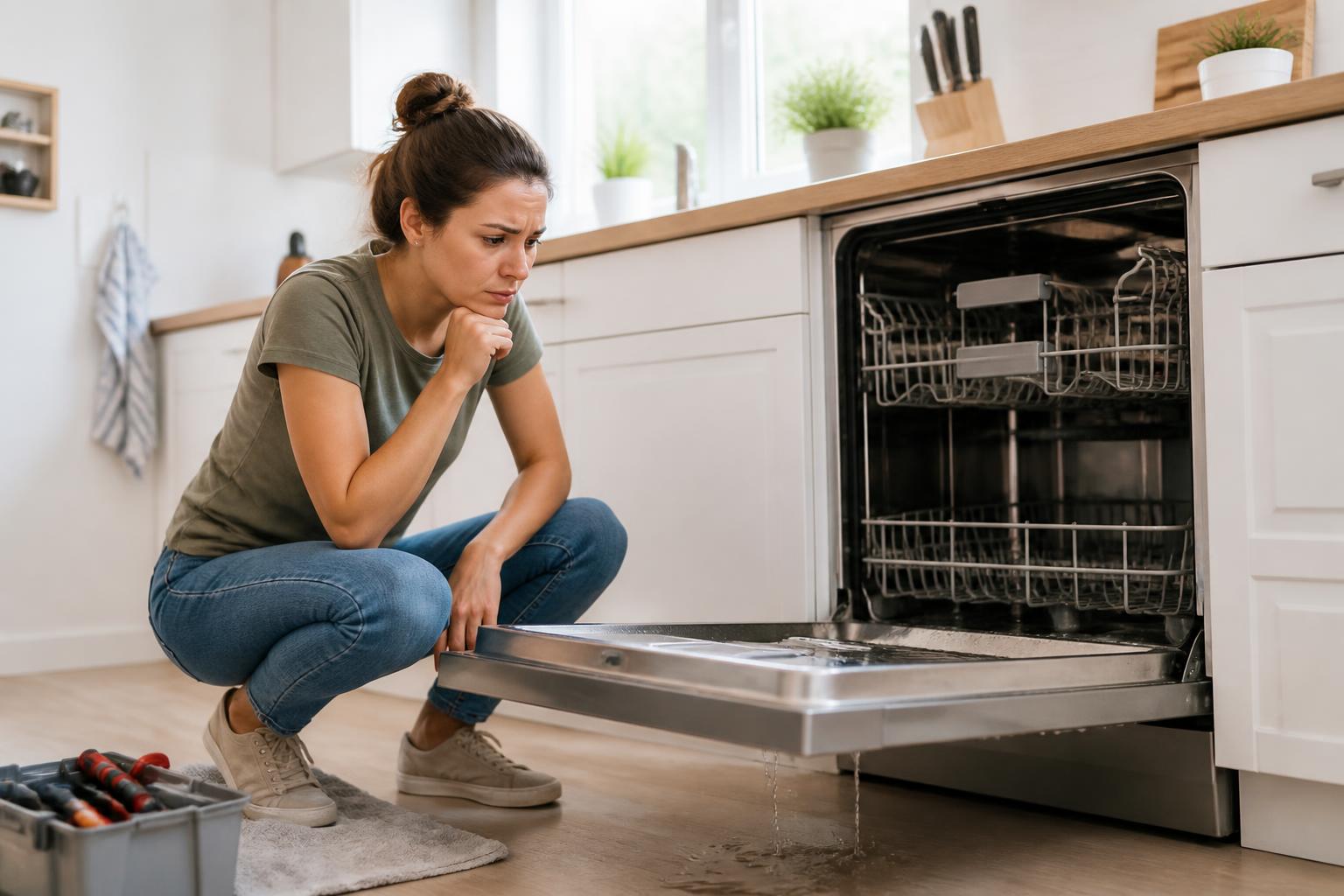
When the control panel shows “E24” (sometimes displayed as “E:24”), the dishwasher’s leak protection system has tripped. The float switch inside the base pan has risen because water is sitting where it shouldn’t be—or the drain pump isn’t moving water out fast enough.
“The E24 error indicates water in the base pan. Before any repairs, unplug the dishwasher and verify the unit is fully drained to avoid electrical shock.” — Bosch Service Manual (paraphrased from safety section)
Don’t ignore it. Running the dishwasher with water in the base pan can damage the main control board or cause floor damage.
Quick Troubleshooting Checks
Before you open any tools, run through these five checks. Each takes under two minutes and solves roughly 70% of E24 codes.
| Check | What to Look For | Pass / Act |
|---|---|---|
| Visible standing water inside the tub | Water pools at the bottom after a cycle | If yes → proceed to filter/hose checks |
| Drain filter cleanliness | Food debris, grease, or a layer of sludge | If blocked → clean and retest |
| Drain hose kink | Hose bent sharply between dishwasher and sink drain | If kinked → straighten or reroute |
| Garbage disposal knockout plug | If connected to disposal, the plug may still be intact | If solid → remove plug |
| Base pan moisture (via front kickplate) | Puddle or dampness under the machine | If wet → locate leak before testing drain |
If any check fails, fix it and then run a rinse cycle. If the E24 clears, you’re done. If not, move to the structured diagnostic.
Pinpointing Why the E24 Code Appeared
The cause almost always falls into one of three buckets. Identify which one you’re dealing with based on what you see.
Clogged Drain Path (Most Common)
Food scraps, broken glass, or a lost utensil can block the drain pump impeller or the filter assembly. On Bosch units, the fine filter (the mesh cylinder) and the coarse filter (the flat screen under the lower rack) need to be removed and rinsed under hot water. Pull the fine filter straight up—if it’s packed with debris, that’s your culprit. A recurring clog after cleaning often means hard water scale is binding the impeller; try running a descaling cycle with a citric acid cleaner before assuming the pump is bad.
Drain Hose or Air Gap Problem
A high-loop hose that’s too low, a clogged air gap on the sink, or a connection that’s not properly secured will all trap water in the machine. Check the hose route: it should rise to at least the height of the countertop before dropping to the drain connection. The air gap (the small chrome or plastic cylinder on the sink edge) is often forgotten—pop off the cap and look for a gelatinous sludge buildup. A bottle brush and hot water usually clear it in 30 seconds.
Failed Drain Pump or Leak
If the filters and hose are clear but water still stays in the tub or the base pan, the drain pump may have seized. Use a multimeter to test continuity on the pump terminals (remove the lower side panel to access the pump). A reading near zero ohms means the motor is good; infinite resistance means the pump is dead. Also inspect the pump housing for cracks and the seals on the hose connections.
Common Mistake: Not Drying the Base Pan After Fixing
One of the most frequent recurrence patterns: you clear the drain, the pump runs fine, but the E24 reappears within a few days. The problem is that the base pan stays wet from the original leak, so the float switch remains lifted. Even a few tablespoons of trapped water can trigger the error. After fixing the leak or cleaning the drain, tilt the dishwasher back slightly (by the top edge), soak up all moisture with towels, and use a hairdryer on low heat to dry the pan completely. Then reassemble and test.
Decision Criterion: When to Keep DIY vs Call a Pro
Your next step depends on one factor: whether the dishwasher is still under warranty.
- Under warranty (3–5 years from purchase): Stop all DIY work immediately. Opening the machine and disconnecting wires voids the warranty on the drain pump and control board. Call Bosch support or an authorized service technician for a free or low-cost repair.
- Out of warranty but less than 7 years old: Proceed with the steps below if you’re comfortable using a multimeter and removing the lower panel. Most drain pump replacements cost $40–$80 for the part and take about an hour.
- Older than 7 years or with a significant leak (water under the front feet): Consider replacement over repair. A new drain pump plus labor can approach $300–$400, and the dishwasher may have other issues surfacing soon.
Step-by-Step Diagnostic Procedure
Follow these steps in order. Each step ends with a “stop” signal that tells you whether the fix is complete or you need to escalate.
Step 1: Reset and Force-Drain
Press the Start button for 3–5 seconds (or hold the Cancel button depending on model) to cancel the current cycle and pump out remaining water. If the drain pump runs but makes a grinding noise, stop—the impeller is jammed and needs manual cleaning. If the pump doesn’t run at all, skip to Step 4.
Step 2: Clean Filters and Check Impeller
- Remove the lower rack and unscrew the fine filter assembly.
- Inspect the flat coarse filter under the wash arm. Scrape off any stuck particles.
- Shine a flashlight into the drain pump opening (the hole under the fine filter). Look for a spinning impeller. If it’s blocked by a piece of plastic or glass, use needle-nose pliers to pull it out.
Success check: Reinstall everything and run a rinse cycle. If the E24 does not return, the fix is done.
Step 3: Inspect the Drain Hose and Air Gap
- Trace the hose from the back of the dishwasher to the sink drain or disposal. Remove any kinks.
- If connected to a garbage disposal, confirm the knockout plug is removed. Remove disposal plug if present.
- Check the air gap on the countertop (small cylinder next to the faucet). Remove the cap—if it’s full of sludge, pick it clean with a bottle brush.
Success check: Run a rinse cycle. If water drains and no E24 appears, you’re done.
Step 4: Measure the Drain Pump Electrical Continuity
This step requires a multimeter set to resistance (ohms).
- Unplug the dishwasher or shut off the breaker.
- Remove the front kickplate and the lower left side panel.
- Locate the drain pump (round black plastic housing near the bottom, connected to the drain hose). Disconnect the wire harness.
- Touch the multimeter probes to the two terminals. A good pump reads below 20 ohms. A reading of OL (open line) means the pump is burned out.
Stop signal: If the pump fails the continuity test, replace it. If it passes but still doesn’t run (and the board sends voltage), the control board may be faulty—that’s a pro job.
Step 5: Inspect the Base Pan for Leaks
Place a few paper towels in the base pan (accessible behind the kickplate). Run a short cycle and then check the towels. If they’re wet, pinpoint the source: hose connections, pump seal, or a cracked tub. Tighten clamps or replace leaking components.
Escalation signal: If you find a leak that you can’t reach or the tub itself is cracked, stop. Call a technician. DIY sealing of a polypropylene tub rarely holds.
Common Follow-Up Questions (FAQ)
Will the E24 code clear itself?
No. The dishwasher must be drained and the base pan dried manually. Simply unplugging and reconnecting power may clear the display temporarily, but the code will reappear if the underlying cause isn’t fixed.
Can I use the dishwasher if E24 shows but the tub seems dry?
Not recommended. A dry tub doesn’t mean the base pan is dry. There could be a slow leak that hasn’t pooled yet. Running the machine while water is in the base pan risks short-circuiting the control board.
How do I dry the base pan after fixing a leak?
Tilt the dishwasher back slightly (by the top edge) so remaining water flows to the front, then soak it up with towels. Use a hairdryer on low heat to dry the pan completely before reassembling.
For a deeper look at how the E24 interacts with other Bosch error codes and when it might be confused with the E25 code, see our guide on understanding the e24 error code on bosch dishwashing machines. If you’re also seeing an E25 error or a different drainage code, the diagnostic steps overlap—check common causes of e25 error on bosch dishwashing machine to rule out a broader problem.