
Maytag Dishwasher Not Cleaning Dishes? Causes and Solutions
If your Maytag dishwasher is leaving food bits, cloudy film, or spots on dishes, the problem is usually a clogged spray arm, dirty filter, or low incoming water temperature. Start with these three checks before tearing anything apart—they fix the majority of cleaning complaints without calling a repairman.
What’s blocking your Maytag dishwasher from cleaning properly?
Most cleaning failures trace back to four common areas. Work through them in order; you’ll often find the culprit in the first two steps.
Quick self-diagnosis checklist
Use this five-point pass/fail scan before you open any tools. Each item takes under two minutes.
- Spray arms spin freely by hand – if they stick or wobble, check for blockages.
- Filter assembly is free of debris and locked in place – loose or food-clogged filters reduce water pressure.
- Water inlet temperature is at least 120°F (49°C) – run the kitchen faucet hot for 30 seconds, then start the dishwasher.
- Detergent door opens fully during cycle – a stuck door wastes detergent and leaves residue.
- No standing water at cycle end – water left in the tub means a drain issue that affects wash performance.
Any “fail” means you have a specific fix in the steps below.
Common cause comparison table
| Symptom | Likely Cause | Fix Order |
|---|---|---|
| Food particles still on dishes | Spray arm jets clogged | Remove and rinse spray arm |
| White filming or cloudy glass | Hard water buildup or low water temperature | Check heater and use rinse aid |
| Greasy residue on plastics | Detergent under-dispensing or wash pump weak | Verify detergent door opens; test wash pump flow |
| Etched glass spots | High heat combined with soft water | Use lower wash temperature |
Step-by-step troubleshooting process
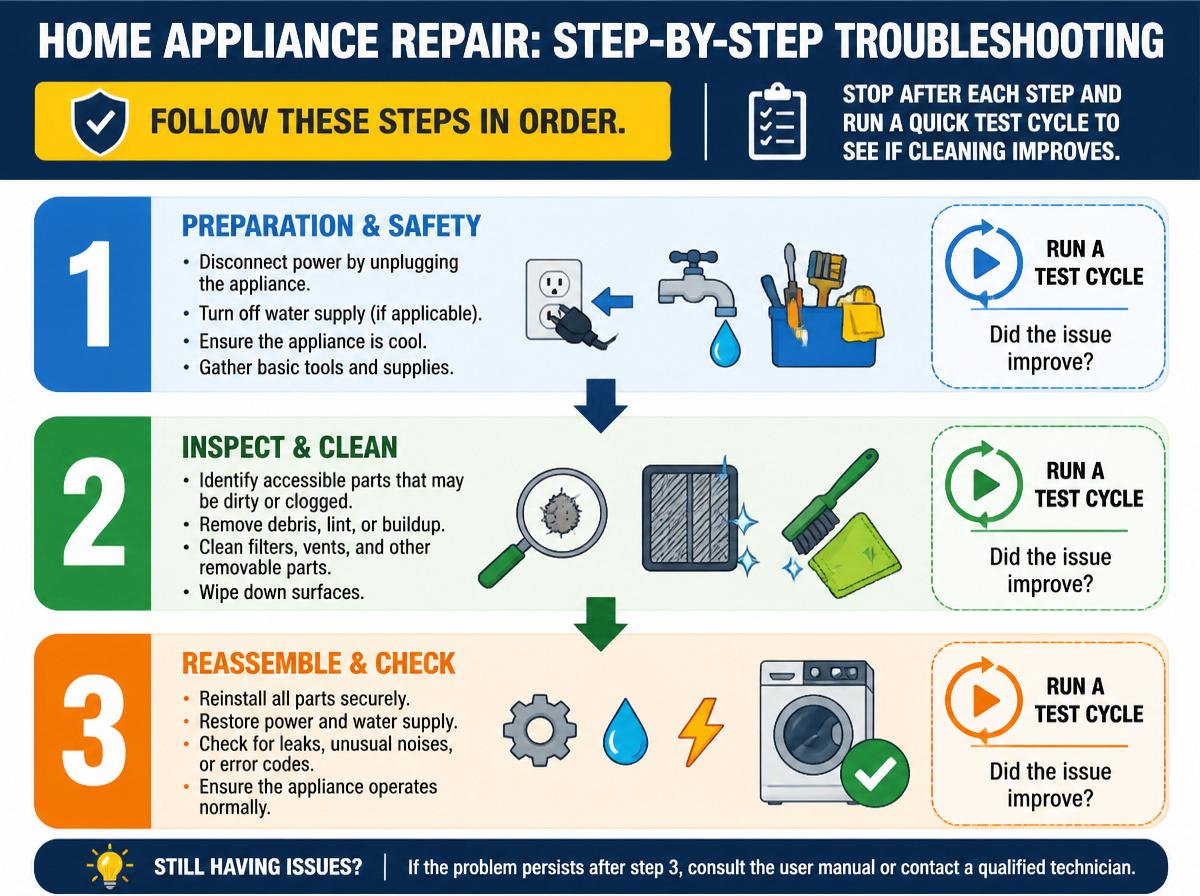
Follow these steps in order. Stop after each step and run a quick test cycle to see if cleaning improves.
Preparation and safety
- Disconnect power by unplugging the dishwasher or flipping the breaker.
- Remove the bottom rack to access the spray arm and filter.
- Have a small brush (old toothbrush works), needle-nose pliers, and a towel ready.
Step 1: Clean the spray arm assembly
The lower spray arm is the most frequent cleaning blocker. Food sediment or a small bone piece can block the water jets.
- Remove the lower spray arm – twist the retaining nut counterclockwise (some models use a push-and-turn lock). Lift it off.
- Inspect each jet – hold the arm under bright light. If you see sediment, poke it out with a toothpick. Run water through the arm to confirm flow.
- Check the arm bearing – spin the arm on the hub. If it feels gritty or stuck, wipe the bearing surface clean.
- Reattach and test – run a rinse cycle with an empty dishwasher. Listen for water sloshing; you should hear the arm spinning.
Common mistake: Only cleaning the lower arm. The upper spray arm and the small center spray cap also need checking. Remove the upper rack to access the upper arm.
Step 2: Inspect and reseat the filter
Maytag dishwashers use a self-cleaning filter system, but large food chunks can bypass the grind mechanism and lodge in the filter screen.
- Find the filter – usually a cylindrical assembly at the bottom center of the tub.
- Twist and lift – turn the filter counterclockwise and pull it straight up. Separate the coarse strainer from the fine mesh screen.
- Rinse both parts under hot water. Use a soft brush to dislodge stuck-on particles. Don’t use a metal scouring pad – it damages the mesh.
- Reinstall firmly – align the tabs, press down, and twist clockwise until it locks. A loose filter reduces wash pressure.
Friction point: If the filter won’t lock, check the O-ring underneath for debris. A misaligned filter causes leaking and poor cleaning.
Step 3: Verify water temperature and detergent delivery
Dishwashers need hot water entering the tub to dissolve grease and activate enzymes.
Check the incoming temperature: Turn the kitchen faucet to hot, let it run full blast for 60 seconds, then measure with a thermometer. If it’s below 120°F, the dishwasher can’t clean effectively. Wait for the water heater to recover or raise the heater thermostat.
Confirm detergent door opens: After the cycle starts, wait 5–10 minutes, then open the door (pause the cycle). The detergent door should be fully open. If not, clean the latch area or replace the spring.
Escalation signal: If the water temperature is fine but dishes still come out greasy, the wash pump may be weak. You’ll hear a low hum instead of a strong rush of water. Pump replacement requires removing the sump – consult a technician.
Step 4: Run a maintenance cycle
Even after fixing specific issues, mineral and grease buildup inside the dishwasher can linger.
- Empty the dishwasher – leave racks in place.
- Add a dishwasher cleaner – use a tablet like Affresh or a cup of white vinegar placed in a bowl on the top rack.
- Run a heavy/ sanitize cycle – skip extra heat dry to avoid baking residues.
- After cycle ends – wipe down the door gasket and around the detergent dispenser.
For a deeper clean on a neglected machine, see how to clean your maytag dishwashing machine with detailed dwell times and rinse steps.
Step 5: Confirm the fix (success check)
Run a clean-load test: Load half of a normal load (not overstuffed), use a quality detergent tablet, and run a normal cycle with heated dry. Open the door immediately after the cycle ends – dishes should be hot, dry, and free of visible food or film. If you still see spots, add rinse aid.
Stop and escalate if:
– Water stays in the tub after the cycle – drain issue (clogged drain hose, bad drain pump, or check valve failure).
– Error codes appear (e.g., F1, F2, F7) – these indicate sensor or control board problems that need professional diagnosis.
– Wash pump sounds like it’s running but no water moves – pump impeller may be broken or the wash motor failed.
Maytag recommends: If the dishwasher fails to complete a cycle or displays an error code after performing the steps above, schedule a service visit. Attempting to disassemble the sump or control board without proper training can void the warranty and cause electrical hazards. — Adapted from Maytag’s official troubleshooting guidelines.
When to call a professional
Some problems go beyond DIY fixes. Schedule a repair if:
- The dishwasher won’t drain after you’ve cleared the filter and drain hose.
- You hear grinding or squealing from the pump area – likely bearing or impeller damage.
- The control panel shows persistent error codes you can’t reset by cycling power.
- Water leaks from under the unit after a cycle.
For similar issues with other brands, refer to common reasons why is my whirlpool dishwashing machine not cleaning for comparative troubleshooting logic.
FAQ (frequently asked questions)
Why is my Maytag dishwasher leaving white spots on glasses?
White spots are usually calcium and mineral deposits from hard water. Add a rinse aid and increase the dispenser setting to the highest level. If that doesn’t help, run a maintenance cycle with a descaling cleaner.
Why does my Maytag dishwasher have standing water at the bottom after a cycle?
Standing water indicates a blocked drain path. Check the filter for debris, then inspect the drain hose for kinks or clogs. If those are clear, the drain pump may be failed or the check valve stuck.
How often should I clean the dishwasher filter?
Clean the filter every month for normal use, or every two weeks if you run it daily or have hard water. A clogged filter reduces water pressure and allows food particles to redeposit on dishes.