
Hotpoint Dishwasher Not Draining: Causes and DIY Fix Guide
When your Hotpoint dishwasher leaves standing water, the problem is almost always in the drain pump, hose, or check valve. Most owners clean the filter and still see water—that’s because the real culprit is often a worn pump impeller that spins but fails to move water. This guide walks you through a safe, structured triage that takes 15 minutes, includes the one check most articles skip, and tells you exactly when to stop and call a technician.
Start with the Quick Triage Checklist
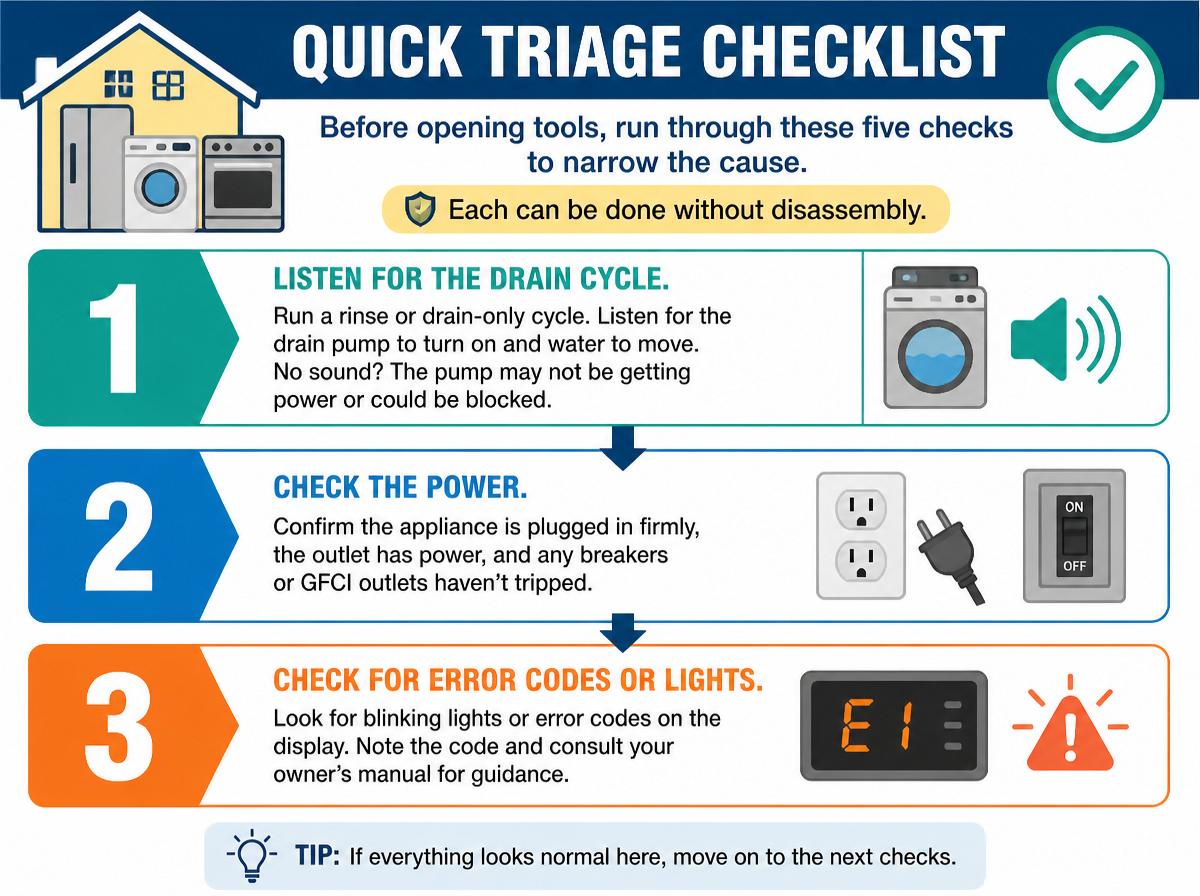
Before opening tools, run through these five checks to narrow the cause. Each can be done without disassembly.
-
1. Listen for the drain cycle. Run a rinse cycle and place your ear against the lower front panel. Do you hear a humming or whirring sound for about 60–90 seconds when the machine should be draining?
– Pass: Pump motor runs → focus on hose or filter.
– Fail: Silence → pump motor, float switch, or control board issue. -
2. Inspect the drain hose routing. Is the hose kinked, pinched behind the kickplate, or looped lower than 33 inches from the floor?
– Pass: Hose is straight, no loops below the sink drain connection.
– Fail: Re-route hose per installation manual. -
3. Remove and examine the sump filter. Lift out the cylindrical filter at the bottom of the tub. Is it coated in grease, food particles, or mineral scale?
– Pass: Filter is visibly clean.
– Fail: Wash filter under hot water and reinstall. -
4. Check the check valve flap. Look inside the sump opening on the right side of the filter area. Can you see a small rubber flap that moves freely? If it’s stuck open, water can drain into the tub after the pump stops.
– Pass: Flap closes fully when pushed.
– Fail: Valve needs cleaning or replacement. -
5. Feel for water movement during drain. With the machine off, place a cup under the drain hose outlet in the sink. Run a short drain cycle. Does water flow strongly for at least 30 seconds?
– Pass: Strong flow → likely a check valve or electrical issue.
– Fail: Weak or no flow → pump impeller or hose blockage.
Branch decision based on your results: If you hear the pump humming (Pass on item 1) but get weak flow (Fail on item 5), your impeller is the most probable cause—skip hose checks and go directly to the impeller inspection below. Conversely, if the pump is completely silent (Fail on item 1), the motor or float switch is more likely; test the motor with a multimeter before disassembling the pump housing. Following the wrong branch wastes time and risks re-seating parts unnecessarily.
According to the International Residential Code, dishwasher drain lines must be installed with a high loop at least 33 inches above the floor to prevent siphoning. A hose routed below that height can pull water back into the tub after the drain cycle finishes.
The Counter-Intuitive Cause Most Owners Miss
The most common reason a Hotpoint dishwasher drains slowly or not at all is not a clogged filter or a jammed pump—it’s a broken pump impeller that appears to work but doesn’t move water. Here’s how to confirm it:
- Symptom: You hear the pump humming normally, the filter is clean, the drain hose is clear, yet water barely trickles out during the drain cycle.
- Mechanism: The impeller (a plastic wheel inside the pump housing) has stripped splines or a cracked hub. The motor spins, but the impeller freewheels on the shaft.
- Check: Disconnect power. Remove the lower kickplate and locate the drain pump (plastic cylinder with two hoses). Stick a long screwdriver gently into the pump intake and try to rotate the impeller by hand. If it spins with no resistance or wobbles, the impeller is broken.
- Why most guides miss this: They focus on the filter and hose because those are easy checks, but the impeller failure has no visible debris and the motor still produces sound, leading owners to assume the pump is fine. The same oversight can happen on other brands—see the step by step guide to repairing your Whirlpool dishwasher for a similar impeller test.
Fix: Replace the drain pump assembly. Most Hotpoint models use a common design. Repair time is about 30 minutes.
Step-by-Step: Clearing the Drain Pump Area
If your triage pointed to a blockage or debris in the pump housing, follow these steps.
- Disconnect power and water. Unplug the dishwasher or flip the breaker. Turn off the water supply under the sink.
- Remove the lower access panel. Use a screwdriver to remove the two screws at the bottom front. Pull the panel forward.
- Place a shallow pan under the pump. Remove the hose clamp and disconnect the drain hose from the pump. Expect residual water—about 1 cup.
- Inspect the pump inlet. Shine a flashlight into the pump body. Look for food scraps, toothpicks, or broken glass. Use needle-nose pliers to extract any debris.
- Check the impeller. Reach into the pump with a finger or a dull probe. Turn the impeller by hand. It should rotate smoothly with slight resistance. If it spins freely, see the impeller section above.
- Reassemble. Reattach the hose and clamp, replace the access panel, restore power and water, and run a short rinse cycle.
Verification step – confirm the fix worked: After the rinse cycle completes, open the door. The tub should be nearly dry with no standing water. Place your hand near the drain hose outlet during the drain phase—you should feel a strong, continuous water stream for at least 30 seconds. If there is any hesitation or sputtering, repeat the debris check or test the check valve flap.
Common mistake: Forgetting to reinstall the filter before running the cycle. Debris that you dislodged can re-enter the pump. If you’re working on a Frigidaire model, the step by step guide to repairing your Frigidaire dishwasher covers a slightly different pump orientation.
| Symptom | Likely Cause | DIY Difficulty | Repair Time |
|---|---|---|---|
| Humming but no water flow | Stripped pump impeller | Medium (access + part swap) | 30 min |
| No sound, no drain | Failed drain motor or float switch | Medium (multimeter needed) | 45 min |
| Water drains then returns | Check valve stuck open or missing | Easy (remove and clean flap) | 15 min |
| Slow drain over filter area | Clogged sump filter or grease buildup | Easy (clean filter) | 5 min |
When to Stop DIY and Call a Technician
Stop home repair if any of these conditions appear:
- You have removed the pump and the impeller looks fine, the motor runs, but the hose is still blocked beyond reach. A professional can snake the drain line or clear the garbage disposal connection.
- The multimeter shows no continuity in the drain motor winding. Replacing the motor requires disassembling the tub—doable but risk of water leaks if not sealed properly.
- The float switch is stuck due to a broken float housing. This part is inexpensive, but accessing it often means removing the entire sump assembly, which is best left to a technician if you’re not comfortable with wiring.
Escalation signal: If the dishwasher still fails to drain after verifying the filter, hose, check valve, and impeller, the control board may not be sending a drain command. This is a rare fault that requires diagnostic equipment most homeowners don’t have.
For a broader perspective on drain troubleshooting across brands, refer to the how to fix a ge dishwasher not draining guide—the logic of checking pump sound before disassembly remains the same.
Quick Check: What Did You Confirm?
- [ ] Drain pump makes noise during cycle → yes / no
- [ ] Filter is clean and reinstalled → yes / no
- [ ] Drain hose is above 33 inches, no kinks → yes / no
- [ ] Check valve flap closes properly → yes / no
- [ ] Impeller turns with normal resistance → yes / no
If you answered “yes” to all five but water remains, the issue is likely electrical or a hidden restriction in the under-sink drain line. A service call is justified.