
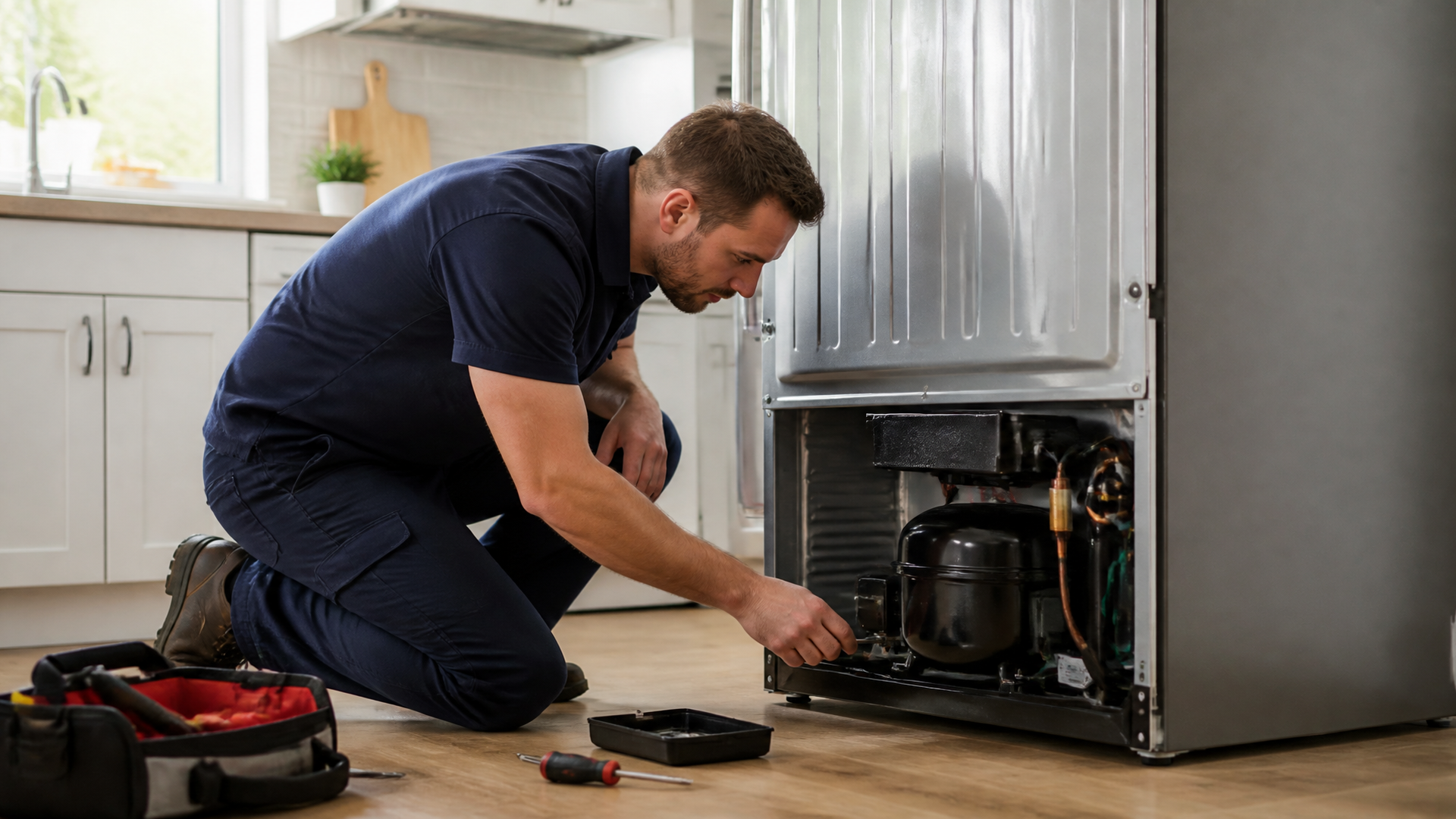
GE Fridge Not Cooling or Leaking? 6 Common Fixes That Work
Most GE refrigerator issues are resolved by cleaning condenser coils, resetting the control board, or replacing a temperature sensor. Before you call for service, invest 15 minutes in a structured check: power and control lock, coil cleanliness, freezer temperature, door seal integrity, and condenser fan operation. If the freezer remains above 15°F after these steps, stop and schedule an authorized technician—compressor or sealed-system damage is not a DIY repair.
Quick Safety Triage and First Checks
Before touching any electrical component, run through this pass/fail checklist. It eliminates the simple causes that account for roughly half of all service calls.
- Power and control lock: Is the fridge display on? If dark, check GFCI outlets and the breaker. If a child-lock icon is lit, hold the door alarm and light buttons for 5 seconds to unlock.
- Condenser coil cleanliness: Pull the unit away from the wall. With a soft brush or vacuum, remove dust from the coils under the front grille. Coils caked with lint reduce cooling efficiency by 25–40%.
- Freezer temperature: Place a thermometer in a glass of water in the freezer. If it reads above 15°F, the fridge section will struggle to stay below 40°F.
- Door seal integrity: Close a dollar bill halfway into the door. If you can pull it out without resistance, the gasket is leaking cold air.
- Condenser fan (if accessible): Listen near the bottom rear panel. If the fan is silent when the compressor is running, it may be seized or burned out.
If any check fails, move to the corresponding fix below. If all pass but the problem persists, the fault is likely in the control board or sealed system, and you should call a technician.
Most Common Causes and How to Rule Them Out
Each cause maps to a specific symptom. Matching what you observe to the right bucket prevents unnecessary part replacements. The table below gives a quick symptom-to-fix cross-reference; detailed explanations follow.
| Symptom | Likely Cause | Quick Check | Fix |
|---|---|---|---|
| Fridge warm, freezer okay | Temperature sensor drift | Measure thermistor resistance at room temp (~4.5kΩ at 70°F) | Replace sensor (WR55X10058, ~$20) |
| Freezer cold, fridge warm, compressor hot | Blocked condenser coils | Check for dust mat behind front grille | Vacuum coils dry |
| No airflow in either compartment | Evaporator fan motor failure | Press freezer door switch; listen for fan | Replace motor (WR60X10256, ~$50) |
| Gradual cooling loss, ice on evaporator | Defrost system failure | Open freezer back panel; check if coils are iced over | Test heater, thermostat, or timer |
| Ice maker small cubes or no ice | Water inlet valve or filter | Listen for valve buzz; replace filter first | Replace valve if filter fails |
| Fridge runs constantly, frost on door | Door gasket leak | Dollar-bill test | Clean or replace gasket |
For a broader view of diagnostic patterns, our guide on identifying testing common problems ge refrigerators covers methods for older and newer models alike.
Temperature Sensor Drift
Symptom: Fridge runs constantly but stays too warm. Freezer is normal or slightly cold.
Check: Measure resistance at the thermistor (usually behind the rear panel inside the fridge) with a multimeter at 32°F and 70°F. GE specs typically call for ~16kΩ at 32°F and ~4.5kΩ at 70°F.
Fix: Replace the thermistor assembly. Cost: $15–$30.
Trade-off: A drifting sensor is often misdiagnosed as a bad main board. Testing resistance is cheaper and faster than swapping a control board.
Blocked Condenser Coils
Symptom: Freezer is cold, fridge is warm, and the compressor runs hot to the touch.
Check: Slide out the front grille. If you see a solid mat of dust or pet hair, coils are the likely culprit.
Fix: Clean coils with a coil brush and vacuum. Do not use a wet cloth.
Branch: After cleaning, check the freezer temperature again in 2 hours. If it has dropped below 10°F, the fix worked. If still above 15°F, the evaporator fan or defrost system is suspect—move to the next section.
Common mistake: Spraying water on coils can damage nearby electronics. Dry vacuum only.
Evaporator Fan Motor Failure
Symptom: No airflow in the freezer or fridge compartment. Fan may make grinding or clicking sounds, then stop.
Check: Open the freezer door and press the door switch. If the fan inside the back wall does not spin, it may be jammed by ice or the motor is dead.
Fix: Remove the freezer back panel. If ice has frozen around the fan, check the defrost heater. If the fan is free but doesn’t spin, replace the motor (part number WR60X10256 or compatible, ~$50).
Verification: After installing the new motor, close the freezer door and listen for airflow within 5 seconds of the door switch engaging.
Escalation signal: If the fan motor is seized and the shaft is blackened, stop—don’t force it. Replace immediately.
Defrost System Failure
Symptom: Fridge gradually loses cooling power, then the evaporator coils become a block of ice. The freezer may make unusual thumping sounds.
Check: After the fridge runs for 8 hours, open the freezer back panel. If the evaporator coils are heavily frosted or iced, the defrost heater, defrost thermostat, or defrost timer (or control board) is failing.
Fix: Test the defrost heater for continuity (should read ~25Ω). Test the defrost thermostat (open when above 50°F, closed when below). Replace the failed component.
Why this matters: The sealed system is rarely the cause in this scenario—replacing the defrost thermostat fixes 80% of frost issues without touching refrigerant lines.
Water Inlet Valve and Ice Maker Failures
Symptom: Ice maker produces small cubes, no ice, or water leaks from the back of the fridge.
Check: Listen for a buzzing sound when the ice maker calls for water. If the valve clicks but no water flows, the valve’s solenoid may be weak or the filter is clogged.
Fix: Replace the water filter first (often overlooked). If no improvement, test the water inlet valve for continuity (2–3kΩ). A failed valve requires replacement (~$40).
Trade-off: Changing the filter costs $10–$20 and takes 2 minutes; testing the valve requires a multimeter. Always run the filter test before ordering a valve.
Door Gasket Leak
Symptom: Fridge runs longer than normal, frost builds on the door frame, and you feel cold air escaping.
Check: Perform the dollar-bill test at multiple points around the door.
Fix: Clean the gasket with mild soap. If still loose, heat it with a hair dryer on low for 10 seconds to restore shape. For torn or flattened gaskets, replace the entire seal.
Trade-off: Replacing a gasket takes 30 minutes and costs $40–$80, but it prevents the compressor from cycling excessively—saving 10–20% in energy usage.
Step-by-Step Repairs You Can Do at Home
Once you’ve identified the likely cause using the checklist or table above, follow the appropriate fix in order. Each step includes what to expect, what not to do, and a verification point. For a full walkthrough of these procedures, see our detailed guide on diy fixes common issues with your ge refrigerator.
1. Clean the Condenser Coils
- Pull the fridge away from the wall and unplug it.
- Remove the lower front grille (snaps off on most models).
- Use a condenser coil brush (long nylon bristles) to loosen dust, then vacuum with a crevice tool.
- Expect: The compressor will run less erratically within 1–2 hours. Verify with a thermometer in the freezer: should drop to 0°F or below within 4 hours.
- Branch: If after 4 hours the freezer is still above 10°F, the problem is not just dirty coils—proceed to Step 2.
- Avoid: Using a wet cloth or chemical cleaner—they can corrode the copper tubes.
2. Reset the Main Control Board
- Unplug the fridge for 5 full minutes. Plug back in and wait 5 seconds.
- Expect: The board performs a self-test. Lights may flash; this is normal.
- Verification: After reset, listen for the compressor to kick in within 2 minutes. If it doesn’t, or if error code reappears, the board may be faulty.
- Common mistake: A 10-second unplug is often too short for capacitors to fully discharge. Two minutes is the minimum for GE boards.
3. Replace the Water Filter
- Locate the filter in the grille or inside the fridge.
- Twist the old filter ¼ turn counterclockwise and pull out.
- Insert the new filter, push, and twist clockwise. Run 2–3 gallons of water through the dispenser to purge air.
- Expect: Ice maker production should return to normal within 24 hours.
- Friction point: After filter replacement, the “Replace Filter” light may not reset automatically. Press the “Reset” button on the control panel for 3 seconds.
- Verification: Check ice production after 24 hours—should see full-sized cubes.
4. Test and Replace a Temperature Sensor
- Remove the rear panel inside the fridge by unscrewing the Phillips screws.
- Disconnect the thermistor connector. Measure resistance at room temp (70°F) and compare to spec (~4.5kΩ).
- If out of range by more than 10%, order a replacement (part number WR55X10058 or equivalent).
- Snap in the new sensor and reconnect.
- Verification: Temperature readings should stabilize within 8 hours. Use a thermometer to confirm the fridge reaches 37-40°F.
- Warning: If the new sensor doesn’t change the behavior, the control board may be misinterpreting the signal—a deeper issue requiring a technician.
5. Check and Replace the Door Gasket
- Clean the gasket with mild soap and water.
- Inspect for tears, cracks, or flattened sections.
- If the dollar-bill test shows a weak seal, heat the gasket with a hair dryer to restore its shape (10 seconds on low).
- If still loose, replace the gasket. GE gaskets are held in by a metal clip under the plastic backing. Pry the clip out with a flathead screwdriver, remove the old gasket, and press the new one into the channel.
- Verification: After replacement, repeat the dollar-bill test around the entire door. The bill should resist being pulled out.
- Avoid: Using superglue on the gasket—it creates hard spots that prevent proper sealing.
When to Stop and Call a Professional
Some problems are not safe or cost-effective to fix yourself. Stop troubleshooting and escalate if any of these apply:
- Compressor won’t start after a forced reset (unplug 30 minutes). A click but no run indicates a bad start relay, but replacing it without a multimeter check can damage the compressor.
- Sealed system hiss or oil stain near the back panel. Refrigerant leaks require a certified EPA technician; you cannot purchase R-134a or R-600a without a license.
- Control board error code that repeats after a reset. For example, code “H2” on GE displays means high temperature alarm—further diagnostics need a service manual and multimeter.
- Fridge age over 10 years and repair cost exceeds 50% of a new model’s price. For a 14-year-old side-by-side, replacing the compressor ($800+) is rarely worth it compared to a $1,200 replacement. Decision rule: if the repair quote plus estimated remaining life (3–5 years) exceeds the cost of a new unit, replace.
- Unusual noise from the back that sounds like a knock or high-pitched squeal. This often signals a failing compressor or fan motor—continued operation can cause a sealed-system breach.
“Always disconnect power before servicing any electrical component inside the refrigerator. Failure to do so can result in electric shock or damage to the control board.” — GE Owner’s Manual, Basic Safety Instructions
For a complete list of diagnostic steps and repair sequences, see our common GE refrigerator repair guide. This page covers the same issues with additional photos and model-specific advice.
Frequently Asked Questions
Why is my GE refrigerator running but not cooling?
The most common cause is blocked condenser coils or a failed evaporator fan. Clean the coils and check the fan inside the freezer. If both are normal, test the thermistor and defrost system before assuming a compressor issue.
How do I reset my GE refrigerator after a power outage?
Unplug the unit for 5 minutes, then plug it back in. Wait 10 seconds for the control board to restart. For older models with a mechanical defrost timer, rotate the timer knob manually one step to defrost and then back.
What does the flashing red light on a GE refrigerator mean?
A fast-flashing red light next to the “Power” indicator signals a high-temperature alarm. Usually the freezer is above 20°F due to a door left open, ice blockage, or power interruption. Clear any ice from the evaporator fan, ensure the door is fully closed, and let the fridge stabilize for 8 hours. If the light continues, check the thermistor or defrost system.