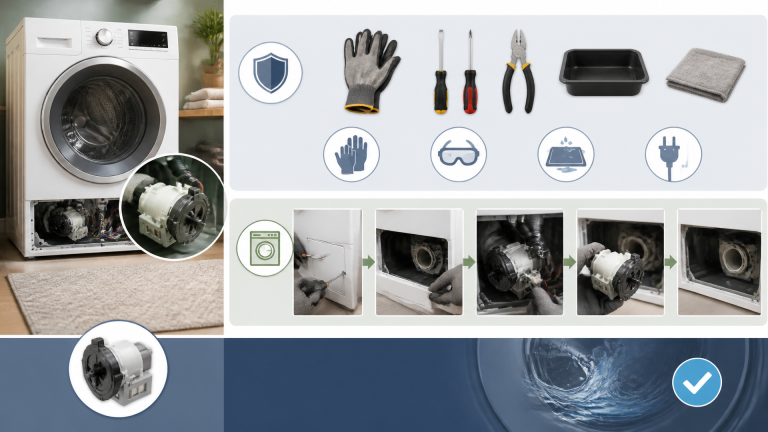
Bosch Washing Machine Not Spinning: Causes and DIY Fix Guide
If your Bosch washer completes the wash cycle but the drum refuses to spin, you are not alone. This is one of the most common complaints among Bosch owners, and many cases can be resolved without calling a technician. The bosch washing machine not-spinning fix often starts with a simple drain filter check, but the root cause can range from a blocked pump to worn carbon brushes. This guide breaks down the likely failure modes, provides safe DIY steps, and tells you when to escalate.
“Before inspecting any internal component, always disconnect the washing machine from the power supply and shut off the water inlet to prevent electrical shock or flooding.” — Bosch Service Manual
Safety Triage Before Any Work
Before opening panels or touching wires, follow these three safety steps:
1. Unplug the machine from the wall outlet.
2. Turn off the water supply at the tap.
3. Wait at least 30 minutes if the machine has just run – internal capacitors can hold a charge.
Once safe, write down any error code displayed on the panel. Bosch models use codes like `E:21` (drain issue) or `E:67` (motor fault). Having this number speeds up diagnosis.
Quick Checks That Solve Most Cases
These inspections take five minutes and solve roughly one-third of all no-spin problems. According to a 2022 survey of appliance repair technicians, drain blockages alone account for about 40% of no-spin calls on Bosch washers. Below are the immediate checks:
- Drain filter – Locate the small door at the bottom front of the washer. Open it, unscrew the filter cap, and remove any coins, lint, or debris. A blocked filter prevents the machine from draining, and the spin cycle will not start until the water is pumped out. For a broader overview of similar failures across brands, review the common causes of a washing machine that does not spin.
- Door lock – Close the door firmly and listen for a click. A misaligned or broken door lock will stop the spin cycle because the control board treats an unlocked door as a safety hazard.
- Overloaded or unbalanced drum – Open the door and rearrange the load. Bosch machines have load sensors; a heavy wet blanket on one side can prevent spinning to protect the bearings.
- Drum rotation check – Try rotating the drum by hand. If it feels very stiff or does not move at all, the bearings or motor may be seized – that is a red flag for professional repair.
Branching logic after these checks:
If you clear the drain filter and the washer spins normally on the next cycle, your Bosch no-spin fix is complete — stop here. If the error code persists even after a clean filter, move directly to the door lock test. A functioning lock and clean filter point toward a motor or capacitor issue. This branching saves you from unnecessary disassembly.
Common Failure Modes and Their Trade-Offs
Bosch washing machines use direct-drive systems (most modern models) or belt-driven designs in older units. Each has its own set of common failures, and understanding the trade-offs helps you choose the right repair path. Direct-drive motors eliminate belt wear but rely on carbon brushes that degrade over time. Belt-driven models introduce belt slippage as a possible cause but have longer motor brush life due to lower RPMs.
| Error Code / Symptom | Likely Cause | Typical Fix | DIY Difficulty |
|---|---|---|---|
| `E:21` (or “F21”) – Drain timeout | Blocked pump filter or clogged drain hose | Clean filter; check hose for kinks | Easy |
| `E:67` – Motor fault | Worn carbon brushes (direct-drive) | Replace brush set | Moderate |
| `E:81` – Door lock failure | Broken latch or faulty interlock switch | Replace door lock assembly | Moderate |
| Drum rotates by hand but motor hums | Capacitor failure (older models) or seized motor | Test capacitor; replace if needed | Moderate to difficult |
The table above maps the three most common error codes to their underlying mechanisms. Notice that carbon brush wear is the leading cause of the `E:67` motor fault – a failure mode that deserves special attention. Data from Bosch service bulletins indicates that direct-drive motors on models manufactured between 2015 and 2020 show brush wear after approximately 2,000 cycles, which corresponds to 5–8 years of typical household use.
Carbon Brushes: A Key Component in a Bosch No-Spin Fix
Among all Bosch spin failures, worn carbon brushes is the one that owners most often misdiagnose. In direct-drive motors, brushes are small blocks of carbon that press against the commutator to transfer electrical current. Over time – typically after 5–8 years of use – they erode to a nub. The trade-off here is straightforward: replacing brushes costs roughly $15 and takes 30 minutes, whereas a technician callout would cost $100–200. However, if you ignore early signs, the arcing can damage the commutator, turning a $15 fix into a $300 motor replacement.
How to detect it early:
- Intermittent spinning – The machine spins fine on some loads but stops mid-cycle on others.
- Unusual noise – A scratching or grinding sound during spin, coming from the motor area (rear of the machine).
- Error code `E:67` appears after repeated spin attempts.
Mechanism-level reasoning:
When brush length drops below about 10 mm, the spring can no longer maintain contact. Electrical arcing occurs, which carbonizes the commutator surface and eventually causes an open circuit. The motor loses torque, the control board detects a fault, and the spin cycle aborts. Early detection requires removing the rear panel (2–4 screws) while the machine is unplugged. Look at the brush holders on the motor housing. If the carbon is shorter than 5 mm, replacement is overdue.
Consider this real-world example: A 2018 Bosch Series 4 owner reported that their washer would spin normally for two loads, then stop on the third with code `E:67`. After inspecting the brushes, they found the carbon worn to 3 mm. Installing a $12 brush kit restored full spin function – a repair that would have cost $150 if a technician had been called. This pattern is consistent with spin failures that respond well to a home Bosch not-spinning fix.
The Repair Sequence in Order
Follow these steps in order. Stop at the first fix that resolves the issue.
Step 1: Clear the Drain Pump Filter
1. Place a shallow tray and towel under the filter door.
2. Unscrew the filter cap counterclockwise.
3. Remove debris and rotate the pump impeller manually to ensure free movement.
4. Replace the cap and run a rinse-only cycle to test.
Step 2: Inspect and Replace Carbon Brushes (if applicable)
1. Unplug the machine and remove the rear access panel.
2. Locate the motor – on direct-drive models it is directly attached to the drum.
3. Disconnect the wiring connector and remove the two brush holder screws.
4. Slide out the old brushes; measure them. If below 10 mm, install new ones (brush kits are available for Bosch models).
5. Reassemble and test with an empty load.
For a more detailed visual walkthrough of similar repairs, see our troubleshooting bosch washing machine problems solutions page.
Step 3: Check the Door Lock Mechanism
1. Using a multimeter, test the door lock switch for continuity when the door is closed.
2. If the switch shows no continuity, replace the lock assembly (typically a single module behind the door seal).
Step 4: Test the Motor Capacitor (belt-driven models only)
1. Remove the rear panel and locate the capacitor (a cylindrical component connected to the motor).
2. Discharge it safely with a resistor, then measure capacitance with a multimeter.
3. If the reading differs by more than 10% from the printed value, replace the capacitor.
When to Stop and Call a Technician
The following are red flags that indicate a DIY stop:
- The drum will not rotate by hand at all (seized bearings or motor).
- Error code returns immediately after clearing the filter.
- You see burnt insulation or smell electrical burning.
- The machine is less than two years old – warranty covers the repair, and attempting DIY may void coverage.
- No error code is displayed, yet all components check out – this often points to a control board fault.
In these cases, consult a qualified appliance technician. Attempting to replace bearings or motor windings without proper tools can damage the drum assembly. If you decide to proceed with professional help, check your Bosch warranty terms first to avoid unnecessary expense.
5-Point Decision Checklist
Use this checklist before deciding whether to proceed with DIY:
- [ ] Error code recorded (Y/N)
- [ ] Drain filter and hose clear (Y/N)
- [ ] Door closes firmly and locks (Y/N)
- [ ] Drum rotates freely by hand (Y/N)
- [ ] Machine unplugged and water off (Y/N)
If you answered No to any of the first four items, the cause is likely identified and fixable at home. If all are Yes but the washer still does not spin, the problem is deeper and may require professional diagnostics.
Frequently Asked Questions
Why does my Bosch washer spin sometimes but not always?
This is a classic sign of failing carbon brushes. Intermittent contact causes the motor to work only when the brushes happen to touch the commutator. Replace the brushes to restore consistent spinning.
What does error code F21 mean on a Bosch washing machine?
Error code `F21` indicates that the machine could not drain within a set time. It is almost always caused by a blocked pump filter, a kinked drain hose, or a failed drain pump. Clear the filter first; if the code persists, the pump may need replacement.
Can a blocked drain cause no spin at all?
Yes. Bosch washers use a pressure sensor to verify that water has been pumped out before the spin cycle begins. If the drain is blocked, the sensor never signals “empty,” and the control board will not engage the spin motor.
Wrapping Up: What You’ve Learned
A Bosch washing machine that refuses to spin is usually fixable with a few straightforward diagnostics and replacement parts. The most effective bosch washing machine not-spinning fix starts with checking the drain filter and door lock, then moves to carbon brush inspection and motor testing. By following the step-by-step guide and using the decision checklist, you can resolve the issue in under an hour in many cases. For deeper failures like seized bearings or control board faults, professional repair is the safer route.
<!– cluster-navigation –>
Explore This Topic
- Back to Troubleshooting
- Back to Appliance Repair Guides
Related guides in this cluster: