
Appliance Repair Cost Guide 2026: Average Prices by Brand, Problem and Appliance
The average appliance repair costs between $100 and $400 nationally, with refrigerator compressor replacements reaching $1,250. The U.S. appliance repair industry is a $7.0 billion market with 37,769 businesses. This guide breaks down repair costs for every major appliance — by problem type, by brand tier, and by the decision that matters most: repair or replace.
National Averages by Appliance Type
| Appliance | Typical Repair Cost | Major Repair Cost | Replacement Cost |
|---|---|---|---|
| Refrigerator | $150 – $600 | $700 – $1,250 (compressor) | $600 – $2,300 |
| Washing Machine | $150 – $350 | $400 – $600 (transmission) | $600 – $1,800 |
| Dryer | $100 – $400 | $350 – $500 (motor) | $800 – $1,200 |
| Dishwasher | $100 – $400 | $350 – $500 (pump + control) | $400 – $1,000 |
| Oven / Range | $100 – $400 | $400 – $600 (control board) | $500 – $2,000 |
| Microwave | $70 – $300 | $200 – $400 (magnetron) | $200 – $600 |
Sources: HomeGuide 2026, Thumbtack 2026, InvoiceFly, BozmanFix. Service call / diagnostic fee: $50-$100, applied to repair if approved. Labor rate: $100-$175/hour nationally.
Repair Costs by Common Problem
Refrigerator
| Problem | Typical Cost | Common Cause |
|---|---|---|
| Not cooling | $150 – $400 | Dirty condenser coils, failed evaporator fan, thermostat |
| Leaking water | $100 – $300 | Clogged defrost drain, damaged door gasket, water inlet valve |
| Ice maker not working | $150 – $250 | Failed ice maker assembly, frozen fill tube, water inlet valve |
| Noisy / loud | $100 – $300 | Condenser fan motor, evaporator fan motor |
| Compressor failure | $700 – $1,250 | Sealed system issue — often worth replacing if unit is 8+ years |
Washing Machine
| Problem | Typical Cost | Common Cause |
|---|---|---|
| Not spinning | $150 – $350 | Lid switch, drive belt, motor coupling, drain pump |
| Not draining | $120 – $300 | Clogged drain pump, failed pump motor |
| Leaking | $100 – $300 | Fill hoses, door boot seal (front-load), drain hose |
| Not filling | $100 – $250 | Water inlet valve, pressure switch |
| Loud / shaking | $150 – $350 | Suspension rods, shock absorbers, unbalanced load |
Dryer
| Problem | Typical Cost | Common Cause |
|---|---|---|
| Not heating | $100 – $300 | Thermal fuse, heating element, cycling thermostat |
| Not starting | $100 – $250 | Door switch, thermal fuse, start switch |
| Noisy / squeaking | $100 – $300 | Drum rollers, idler pulley, belt |
| Not tumbling | $150 – $350 | Drive belt, drum roller, motor |
Dishwasher
| Problem | Typical Cost | Common Cause |
|---|---|---|
| Not draining | $100 – $300 | Clogged drain hose, failed drain pump, check valve |
| Not cleaning | $100 – $250 | Spray arms clogged, water inlet valve, pump |
| Leaking | $100 – $300 | Door seal, tub gasket, water inlet valve |
| Not starting | $150 – $350 | Door latch, control board, thermal fuse |
Oven / Range
| Problem | Typical Cost | Common Cause |
|---|---|---|
| Not heating (electric) | $100 – $300 | Bake element, broil element |
| Not heating (gas) | $150 – $350 | Igniter, safety valve |
| Door won’t unlock | $100 – $250 | Door lock assembly, control board |
| Error code / control | $150 – $400 | Control board, temperature sensor |
The 50% Rule: When to Repair vs Replace
The industry-standard decision framework:
If the repair estimate is more than 50% of a replacement unit’s cost, replace the appliance.
For a $1,200 refrigerator, the threshold is $600. For a $900 washing machine, it’s $450.
BUT — this rule needs adjustment based on appliance age and brand tier:
- Budget appliance in final third of lifespan → Replace at 30% threshold
- Mid-range in middle of lifespan → Use the standard 50% rule
- Premium appliance in first half of lifespan → Repair even at 60-70% — these units are designed for 20-year service
Repair vs Replace: Key Statistics
From Consumer Reports survey data:
– 58% of consumers replace rather than repair when a major appliance breaks
– 39% of Americans who owned a large appliance that broke disposed of it because they couldn’t find a repair person they trusted
– 43% said the appliance was too old to be worth repairing
– 42% said it was more cost-effective to replace
– Only 36% of large appliance owners successfully completed a repair
The opportunity: Many consumers default to replacement when a repair would be significantly cheaper. Knowing the right numbers changes the decision.
Industry Trends Driving Repair Costs
Tariffs are pushing costs up 5-20%. Import tariffs on parts from China and Mexico — including compressors, circuit boards, and motors — are increasing repair costs in 2025-2026 (IBISWorld).
New appliance prices are climbing. Prices increased 2.2% from 2023 to 2024. As replacement costs rise, repair becomes the better financial choice for more households.
Smart appliances need new repair skills. JD Power 2025 data shows Wi-Fi connected appliances experience 87 problems per 100 units versus 63 PP100 for non-connected. These failures often require software diagnostics plus traditional mechanical repair.
Right-to-repair momentum. Growing support for right-to-repair legislation is expanding access to OEM parts and documentation, making DIY repair more viable.
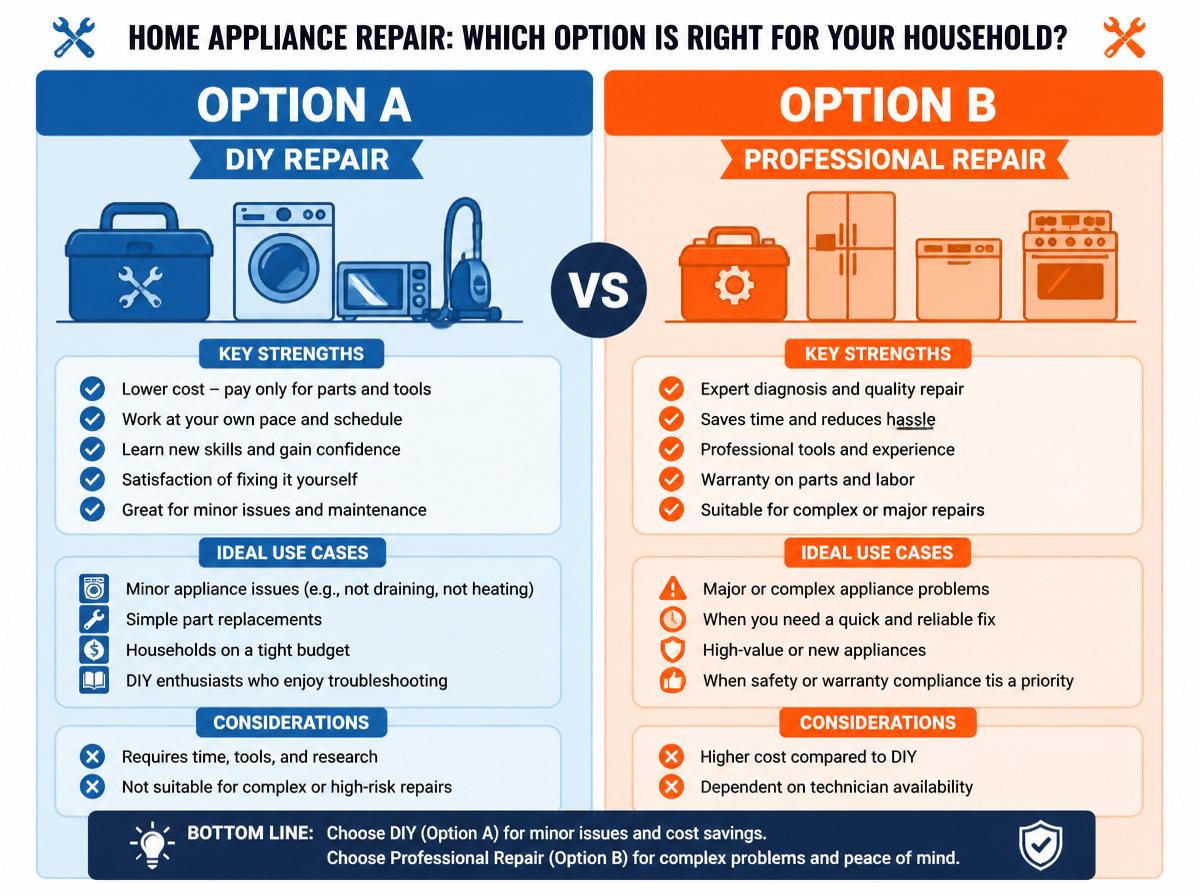
DIY vs Professional Repair
| Approach | Cost | Best For |
|---|---|---|
| DIY with guide | $20 – $150 (parts only) | Simple repairs: filter replacement, belt changes, thermal fuses, lid switches |
| Professional repair | $100 – $400 | Complex repairs: compressor, sealed system, control board, motor |
| Replace | $400 – $2,300 | When repair exceeds 50% of replacement cost |
Safe DIY repairs for most homeowners: Water filter replacement, dryer belt replacement, refrigerator condenser coil cleaning, oven igniter replacement, dishwasher filter cleaning, washing machine lid switch replacement.
Call a professional for: Sealed system work (refrigerant), gas line repairs, control board diagnostics, motor replacement, transmission work.
Related Resource Guides:
Frequently Asked Questions
Why do some repairs cost more than others?
Three factors determine repair cost: part price, labor time, and accessibility. A refrigerator compressor replacement ($700-$1,250) requires specialized refrigerant equipment and 2-4 hours of labor. A dryer thermal fuse replacement ($100-$175) requires a $15 part and 30 minutes of labor.
Is a home warranty worth it?
Home warranties cost $400-$700 annually plus a per-service fee ($75-$125). For older appliances (8+ years) or premium appliance owners, a home warranty can pay for itself with one major repair. For newer mid-range appliances under manufacturer warranty, a home warranty is usually unnecessary.
How do I find a reliable appliance repair service?
Check reviews, ask about diagnostic fees (should be applied to repair cost if approved), confirm they service your specific brand, and ask about parts availability. Independent local shops often provide better value than national chains.
Sources: HomeGuide (2026), Thumbtack (2026), InvoiceFly, BozmanFix Appliance Repair Statistics 2026, IBISWorld Appliance Repair Industry Report (2025), JD Power U.S. Appliance Reliability & Service Study (2025, n=12,755), Consumer Reports Consumer Repair Behavior Survey, U.S. Bureau of Labor Statistics (May 2023).