
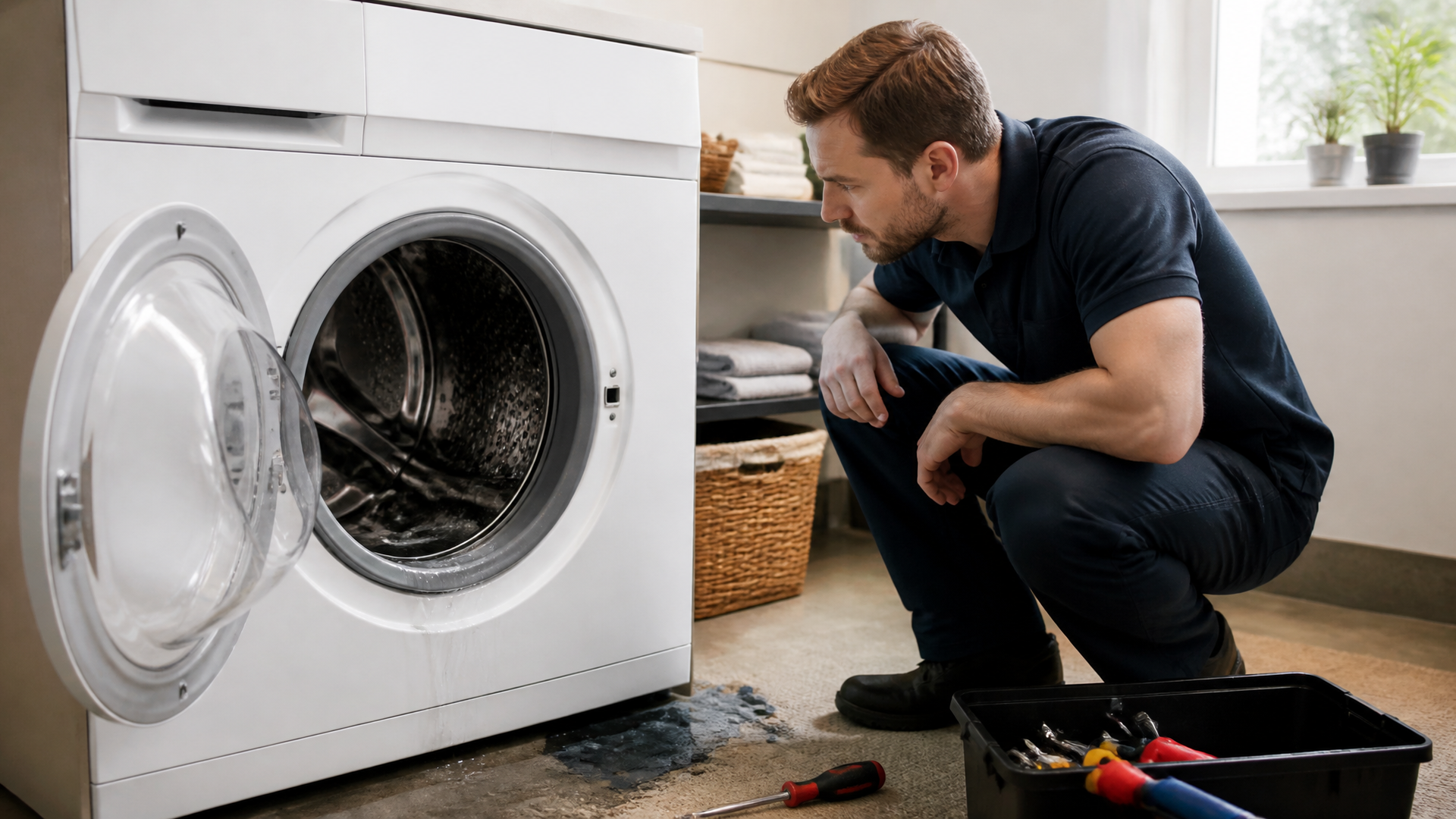
Speed Queen Washer Not Draining? Common Causes and DIY Repair
A Speed Queen washer that leaves standing water in the drum after the cycle ends usually signals a blocked pump, a failed lid switch, or a kinked drain hose. Because these machines use mechanical timers and separate drain pumps rather than integrated electronic boards, the diagnostic order matters more than with other brands. This guide prioritizes checks by likelihood, explains the mechanical trade-offs that affect failure patterns, and gives clear signals for when home repair stops being safe or cost-effective.
How Speed Queen’s Design Affects Drain Diagnosis
Speed Queen washers rely on a mechanical timer and a standalone drain pump instead of the unified electronic control boards found in most consumer brands. This design choice creates a specific set of failure points that are simpler to test but require a different mental model for troubleshooting.
- Mechanical timer: Controls drain and spin phases independently. If the timer fails to advance past the drain position, water stays in the drum even with a fully functional pump. This is rare but worth checking early on older units.
- Drain pump: Belt‑driven on many models, built for higher duty cycles. Lint, coins, and fabric softener residue still accumulate here, but the pump housing is easier to access than on fully sealed electronic machines.
- Lid switch: A mechanical switch that must engage for drain and spin to activate. This is a known wear item on Speed Queen machines after several years—more likely to fail than the electronic lid locks used by other manufacturers.
The practical trade-off is straightforward: repairs are cheaper and require less specialized diagnostic equipment, but you must check components in a specific order to avoid unnecessary disassembly. For a broader look at model-specific fixes, see our step by step solutions speed queen washing machine problems guide.
Likely Causes – Symptom, Check, and Fix
Use this symptom‑driven table to rule out the most common problems without guesswork. The symptom is standing water in the drum after the cycle completes. Each row lists a likely cause, a quick check that takes under two minutes, and the corresponding fix.
| Likely Cause | Quick Check | Fix |
|---|---|---|
| Kinked or blocked drain hose | Look for bends, twists, or visible debris between washer and standpipe | Straighten hose; disconnect and flush if debris is visible |
| Clogged pump filter (lint, coins, fabric softener residue) | Remove lower access panel; locate pump filter | Clear debris by hand or with a wet/dry vacuum |
| Faulty lid switch | Test continuity with a multimeter when lid is pressed down | Replace lid switch assembly |
| Defective drain pump motor | Listen for hum during drain cycle; if silent, measure voltage at pump connector | Replace pump assembly if voltage is present but no hum |
| Standpipe too high or clogged | Measure from floor to top of pipe (should be 30–39 inches); check for lint inside | Clear blockage or adjust standpipe height |
| Timer not advancing | Observe timer during drain cycle; it should move past the drain position | Replace timer mechanism if stuck |
Always disconnect the washer from power before accessing internal components. This is a basic safety requirement per the Appliance Service Safety Standard (ANSI/AHAM HLW-1-2020).
Step-by-Step Drain Repair with Branch Decision and Verification
Follow these ordered steps in sequence. Each step includes what to expect and a common mistake to avoid. The branch after Step 3 helps you decide which component to test next based on what you see.
Step 1: Unplug and shut off water
- Disconnect the power cord from the outlet.
- Turn off hot and cold water supply valves behind the washer.
- Common mistake: Forgetting to shut off water can cause flooding when you open the pump filter cover.
Step 2: Access and clean the pump filter
- Remove the front lower access panel (two screws or clips) or lower kickplate.
- On most Speed Queen models, the pump filter is behind a removable cover. Pull it out and inspect for debris.
- What to expect: A small amount of residual water may drain out. Have a towel and shallow pan ready.
- Clear any lint, coins, or fabric softener sheets by hand. A wet/dry vacuum helps with stubborn lint clumps.
- Reinstall the filter and access panel.
Step 3: Inspect the drain hose and standpipe
- Disconnect the drain hose from the standpipe. Check for kinks, twists, or lint blockage inside the hose.
- Measure the standpipe height from the floor. If it is higher than 39 inches, the pump may not have enough pressure to push water out.
- Common mistake: Assuming a kinked hose is fine if water trickles out. Even partial blockage can prevent full drainage.
Realistic branch after Steps 1–3: If the hose and pump filter are clean but water still remains in the drum, the next step depends on whether the pump motor makes any sound when the cycle tries to drain. Start a drain cycle and listen carefully at the lower front panel. If the pump hums audibly but no water moves, the pump impeller is likely broken or jammed by a foreign object that has passed the filter. If the pump is completely silent (no hum at all), the issue is electrical—most commonly the lid switch, but possibly the timer or a wiring break. This fork changes your next action entirely: a humming pump points to a mechanical pump replacement, while a silent pump points to a switch or electrical test first.
Step 4a: Test the lid switch (if pump is silent)
- Locate the lid switch under the top panel near the lid catch.
- Set your multimeter to continuity (ohm) mode.
- Place probes on the two switch terminals. The meter should beep when the lid is fully pressed down.
- If you get no continuity, the switch is defective. Replace it with a genuine Speed Queen part like the Speed Queen Kit, Tlw Lid Lock for proper fit and longevity.
- Common mistake: Testing the switch with the lid open. It must be fully closed to complete the circuit.
Step 4b: Check the pump impeller (if pump hums but no water moves)
- Unplug the washer and remove the pump assembly from its mounting bracket.
- Inspect the impeller (the plastic fins inside the pump housing) for cracks or debris wedged between the blades.
- If the impeller spins freely by hand but the pump hums when powered, the motor is likely fine but the impeller is stripped. Replace the pump assembly.
- Common mistake: Replacing the entire pump when only the impeller is damaged. Check the impeller first; on some models, you can replace just the impeller if it is sold separately.
Step 5: Verify the repair
- Reconnect everything and run a Rinse & Spin cycle (approximately 10–15 minutes).
- Watch the drain hose during the drain phase. You should hear water flowing steadily through the hose within 60 seconds of the drain cycle starting.
- Stop the cycle after 5 minutes, open the lid, and visually confirm that no standing water remains in the drum.
- Normal behavior: The drum should be nearly dry, with only a few drops of residual water at the bottom. If more than a shallow puddle remains, the fix has not fully resolved the issue.
If your washer also refuses to spin after the drain issue is fixed, the problem may be a broken drive belt or clutch assembly rather than the drain system. Learn how to distinguish the two by reading our guide on common causes of a washing machine not spinning.
Pre-Repair Drain Diagnostic Checklist
Use this quick pass/fail checklist before opening anything. Each item takes less than two minutes and helps you avoid unnecessary disassembly.
| Check | Method | Pass | Fail |
|---|---|---|---|
| Drain hose | Inspect for kinks and dislodge to check flow | Water flows freely when hose is lowered | Kink, twist, or visible blockage |
| Standpipe height | Measure from floor to top of pipe | 30–39 inches | Under 30 or over 39 inches |
| Lid switch (multimeter) | Continuity test with lid fully closed | Beep or continuity reading | No continuity |
| Pump filter | Remove and inspect for debris | Clean | Lint, coins, or softener residue |
| Pump motor hum | Listen during drain cycle with ear near lower panel | Audible hum | Complete silence |
| Outlet power | Test with plug-in tester or multimeter | 120 V | No power or tripped breaker |
| Timer advance | Watch timer dial during drain phase | Moves past drain position | Stays in same position for more than 5 minutes |
If any item fails, address it before running another full cycle. A single blocked hose or a failed lid switch can cause repeated pump damage if you keep running the washer.
When to Call a Technician – Escalation Signals
Some issues are beyond safe or practical DIY repair. Stop and schedule professional service if you encounter:
- Burning smell from the washer during the drain cycle – usually indicates a seized pump motor or overheated wiring that could become a fire risk.
- Water leaking from the pump area after cleaning – the pump housing or seals may be cracked, and replacing the entire pump assembly is safer than attempting a seal repair.
- Repeated lid switch failure – the mounting bracket or wiring harness may be damaged, not just the switch itself. Installing a new switch on a damaged bracket will fail again.
- Timer not advancing – if the timer stays in the drain position even after the lid switch and pump test good, the timer mechanism itself needs replacement. This requires removing the control panel and is easy to damage if you are not experienced.
- Error codes on electronic models (e.g., E1, dL, or F1) – these require diagnostic software or control board replacement that a technician can handle faster and more reliably.
Decision criterion: The washer’s age and the specific failed component change whether repair or replacement makes sense. If the machine is under 5 years old and only the lid switch needs replacing, repair is clearly the better choice (under $40 for the part and 30 minutes of labor). If the washer is over 10 years old and the drain pump motor is burned out, replacement is often more cost-effective. A new pump costs $80–$120 installed, but a machine with multiple worn components (timer, belt, bearings, seals) may fail again within a year.
When the repair cost exceeds 50% of a comparable new machine’s price, replacement is the practical call. For a broader overview of drain fixes that apply across brands, refer to this step by step guide to fixing a washing machine not draining guide.
Frequently Asked Questions
Q: Why does my Speed Queen washer not drain even after I cleaned the pump filter?
A: The lid switch is the next most likely cause. Test it with a multimeter as described in Step 4a. A broken switch prevents the drain cycle from activating, even if the pump is completely clear of debris.
Q: Can a standpipe that is too high cause permanent pump damage?
A: Yes. If the standpipe exceeds 39 inches, the pump must work against excessive backpressure, which can overheat the motor and shorten its lifespan. Lowering the pipe or installing an air gap is the permanent fix.
Q: How do I tell the difference between a bad pump motor and a jammed impeller?
A: Listen during the drain cycle. If the pump hums but moves no water, the impeller is likely broken or jammed. If the pump is completely silent and you measure 120 V at the motor connector, the motor is burned out. If there is no voltage, the issue is upstream—lid switch, timer, or wiring.