Maytag Washer Won’t Drain: Pump, Hose & Lid Switch Fix
A Maytag washer that won’t drain is one of the most frustrating appliance failures you can face. The cycle finishes, the drum is full of soapy water, and your laundry sits soaking instead of moving to the spin phase. The good news? Most drain failures trace back to just three components—the drain pump, the drain hose, or the lid switch—and you can diagnose all three in under an hour with basic tools.
Before you call a repair technician (who will charge $150–$250 just for the service visit), it’s worth understanding the mechanism. When your Maytag washer won’t drain, the machine is telling you something specific: the control board isn’t receiving the signal that water has been evacuated, or the pump physically cannot move water out. Which of those two scenarios you’re dealing with changes your entire repair strategy.
The Drain Sequence: What Should Happen vs. What’s Happening
A top-load Maytag washer follows a predictable drain sequence. The control board energizes the drain pump, which pulls water through the pump inlet, pushes it up through the drain hose, and out into your home’s standpipe. The pump runs for a set duration—typically 2 to 5 minutes—or until a pressure switch confirms the tub is empty.
When this sequence fails, you’ll notice one of three patterns:
1. Complete failure: The washer stops mid-cycle with water still in the drum and makes a humming or buzzing sound.
2. Partial drainage: Water level drops but never fully empties, leaving clothes soaked and the tub with standing water.
3. Silent failure: No pump sound at all; the washer simply sits there as if waiting for something.
Each pattern points to a different root cause. A humming pump that moves no water suggests a clogged pump inlet or a jammed impeller. No sound at all points to an electrical issue—lid switch, control board, or a failed pump motor. Partial drainage often means a partial clog in the hose or a weak pump.
According to appliance repair data, drain pump failures and clogged pump filters account for roughly 60–70% of all “washer won’t drain” service calls across major brands, including Maytag. The remaining cases split between lid switch failures, drain hose kinks, and control board issues. That distribution matters because it tells you where to start: the pump and its filter, not the expensive electronics.
Safety First: Preparing Your Maytag Washer for Diagnosis
Before you touch anything, unplug the washer from the wall outlet. Water and electricity don’t mix, and the drain pump receives line voltage (120V in the US) directly from the control board. Even with the cycle stopped, capacitors can hold a charge.
You’ll also need to deal with the standing water. A washer full of water is heavy—roughly 300–400 pounds when loaded—and tipping it without draining first is dangerous. Here’s how to prepare:
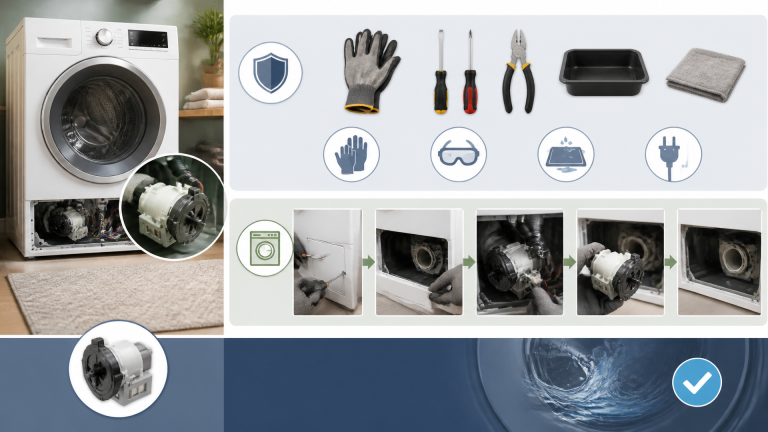
- Gather tools: A multimeter, screwdriver set (Phillips and flathead), pliers, a bucket or shallow pan, towels, and a wet/dry vacuum if you have one.
- Locate the drain hose: It’s usually at the back of the machine, clipped to the cabinet or connected to a standpipe. Lower the hose into a bucket and remove the clamp to let gravity drain the tub. Expect 5–15 gallons depending on load size.
- If the hose is clogged: Use a wet/dry vacuum at the hose opening to pull out debris, or gently insert a plumber’s snake to break up the blockage.
- Check for kinks: A pinched or bent drain hose is a common culprit, especially if the washer was pushed back against the wall recently. Straighten the hose and confirm it has a smooth, upward path to the standpipe.
Once the tub is empty and the machine is unplugged, you can begin the actual diagnosis. If you’re unsure whether the issue is the pump or something else, a step by step guide to fixing a washing machine not draining can walk you through the full sequence.
Early checkpoint that changes your next move: After you’ve drained the tub manually, turn the cycle dial to “Drain & Spin” and listen carefully. If you hear the pump humming but no water moves, you’re dealing with a mechanical blockage—skip the electrical testing and go straight to the pump. If you hear nothing at all, the problem is electrical, and the lid switch becomes your prime suspect before you even open the cabinet.
The Drain Pump: The Most Likely Culprit
The drain pump is a small centrifugal pump, usually located at the bottom of the washer, behind a lower access panel or under the cabinet. It has two jobs: push water out during the drain cycle and recirculate water during the wash cycle (on models with a recirculation feature). When it fails, your Maytag washer won’t drain, and you’ll typically hear a humming sound as the motor tries to spin but can’t move water.
How to Test the Drain Pump
1. Access the pump: Unplug the washer, remove the back panel (or lower front panel, depending on your model), and locate the pump. It’s a plastic housing with two hoses attached—one from the tub, one leading to the drain hose.
2. Inspect the inlet: Remove the hose from the pump inlet and check for debris. Coins, buttons, hairpins, and small clothing items are common offenders. The pump has a filter or a clear cover on many Maytag models; clean it thoroughly.
3. Check the impeller: The impeller is the small plastic fan inside the pump housing. If it’s jammed with a foreign object, the motor will hum but the impeller won’t turn. Remove the obstruction carefully.
4. Test with a multimeter: Set your multimeter to ohms (Ω) and touch the probes to the pump’s two terminals. A healthy pump typically reads between 5 and 15 ohms. If you get an open circuit (infinite resistance) or a short (near zero), the motor winding is burned out and the pump needs replacement.
When to Replace the Pump
If the pump is clogged, cleaning it may solve the problem. But if the motor is dead, you’ll need a new pump. The BlueStars WPW10730972 W10130913 8540024 Washer Drain Pump Assembly is a direct replacement for many Maytag models, and it comes with a lifetime protection guarantee. Before ordering, check your washer’s model number—Maytag uses several pump variants, and the wrong one won’t fit.
Replacing the pump is a 30–60 minute job for most DIYers. Remove the old pump (two screws and two hose clamps), transfer the wiring harness, and install the new one. The BlueStars TB123A Washing Machine Spanner Wrench can help with stubborn hose clamps on Maytag and Whirlpool machines, though a standard pair of pliers usually works fine.
Trade-off to consider: Replacing the pump yourself costs $40–$80 for the part. Hiring a technician costs $200–$350 total. If you’re comfortable with basic tools, the DIY route is clearly cheaper. But if your washer is more than 10 years old and has other issues (noisy spin, failing bearings), the repair cost may exceed the machine’s value—at which point replacement makes more sense.
Branch point based on your multimeter reading: If the pump reads between 5 and 15 ohms, the motor windings are intact, and the problem is almost certainly a jammed impeller or a clogged inlet—clean those and retest. If the reading is infinite or near zero, the motor is burned out, and no amount of cleaning will fix it. That’s your signal to order the replacement part rather than spending more time on the old pump.
The Drain Hose: Kinks, Clogs, and Height Problems
The drain hose is the simplest component in the system, but it causes a surprising number of drain failures. The hose runs from the pump outlet to your standpipe or laundry sink, and it must maintain a specific path: up from the pump, then down into the drain. If the hose is kinked, clogged, or installed at the wrong height, water won’t flow out even with a perfectly good pump.
Common Drain Hose Problems
- Kinks and bends: A sharp bend in the hose restricts water flow. This often happens when the washer is pushed against the wall, pinching the hose between the cabinet and the wall.
- Clogs: Lint, fabric softener residue, and small objects can accumulate inside the hose over time. A partial clog causes slow draining; a complete clog stops it entirely.
- Incorrect height: The drain hose outlet should be 30–96 inches above the floor, per most manufacturer specs. If the outlet is too high, the pump can’t push water up that far. If it’s too low, water can siphon back into the tub.
- Blocked standpipe: The standpipe itself (the vertical pipe in your wall) can clog with lint and soap scum. If the hose is clear but water still won’t drain, check the standpipe with a plumber’s snake.
How to Check the Drain Hose
1. Disconnect the hose from the washer and the standpipe.
2. Inspect it visually for kinks, cracks, or crushing.
3. Run water through it with a garden hose or sink faucet to check for blockages.
4. Clean or replace as needed. A new drain hose costs $10–$20 and takes 10 minutes to install.
One decision criterion that changes the recommendation: the age of the hose. If your washer is less than 5 years old, a clog is more likely than a hose failure. If it’s older than 8 years, the hose may have degraded internally—replacing it preemptively is cheap insurance. This is a low-cost, low-skill fix that resolves a meaningful percentage of drain issues.
The Lid Switch: The Silent Failure Point
The lid switch is a safety mechanism that prevents the washer from spinning or draining with the lid open. On many Maytag models, the drain pump won’t energize at all unless the lid switch is closed and sending a “lid locked” signal to the control board. If the switch fails, your Maytag washer won’t drain—and it won’t make any noise, because the pump never receives power.
How to Test the Lid Switch
1. Locate the switch: On most top-load Maytags, it’s under the top panel, near the lid hinge. You may need to remove the top panel (two screws at the back, then slide it forward) to access it.
2. Inspect the actuator: The switch has a small plastic lever or plunger that the lid presses down when closed. If this lever is broken or stuck, the switch won’t engage.
3. Test with a multimeter: Disconnect the wiring and set your multimeter to continuity mode. With the switch in the “closed” position (lid down), you should see continuity (near-zero resistance). With the lid up, you should see an open circuit. If the switch doesn’t change state, it’s faulty.
4. Bypass test (temporary): Some DIYers bypass the lid switch with a jumper wire to confirm the diagnosis. This is fine for testing, but never run the washer without a functioning lid switch—it’s a safety device that prevents the drum from spinning with the lid open.
Lid Switch vs. Lid Lock
Newer Maytag models use a lid lock assembly instead of a simple switch. The lid lock has two functions: it locks the lid during the spin cycle and sends a signal to the control board. If the lock mechanism fails, the washer may refuse to drain or spin. Testing is similar—check for continuity and proper mechanical operation—but replacement is slightly more involved because the lock assembly includes a solenoid and a position sensor.
Evidence to guide your decision: Lid switch failures are more common on older Maytag machines (pre-2010) and on models that see heavy use. If your washer is newer and the lid locks and unlocks normally during cycles, the switch is probably fine—focus your attention on the pump and hose first. If the lid doesn’t lock or you hear clicking but no locking action, the lid lock assembly is the likely culprit.
Branch point based on what you hear: When you press the lid down and start a drain cycle, listen for a distinct click from the switch area. If you hear the click but the pump stays silent, the switch is mechanically engaging but may have burned contacts—test continuity to confirm. If you hear no click at all, the actuator lever is likely broken or the switch is misaligned, and replacement is the straightforward fix.
Expert Tips for Diagnosing a Maytag Washer That Won’t Drain
These tips come from years of collective appliance repair experience, and they’ll save you time and frustration:
Tip 1: Always check the pump filter before replacing anything. On most Maytag top-loaders, the pump filter is accessible behind a small door on the lower front panel. Open it, remove the filter, and clean out debris. A clogged filter is the single most common cause of drain failure, and cleaning it takes 2 minutes. Common mistake: Skipping this step and ordering a new pump, only to find the old one was fine.
Tip 2: Listen for the pump sound during the drain cycle. Start a drain-only cycle (or spin cycle) and put your ear near the lower back of the washer. If you hear a humming or buzzing sound, the pump is receiving power and trying to work—the problem is mechanical (clog or jam). If you hear nothing, the problem is electrical (switch, wiring, or control board). Common mistake: Assuming silence means a dead pump. It could be a failed lid switch or a broken wire.
Tip 3: Test the washer on a “drain and spin” cycle after any repair. Don’t just run a full wash cycle—that takes 45 minutes. Use the “Drain & Spin” or “Spin Only” cycle to verify the fix. Watch the water level drop and confirm the spin cycle engages. Common mistake: Running a full cycle, discovering the drain works but the spin doesn’t, and having to diagnose a second issue.
When to Call a Professional
Not every drain issue is DIY-friendly. Here are escalation signals that suggest you should call a technician:
- The control board is suspect: If the pump tests fine, the lid switch works, and the hose is clear, the problem may be in the control board. This is a $150–$300 part and requires careful handling of live electronics.
- You’re not comfortable with electrical testing: Working with a multimeter and live wiring is dangerous if you’re not experienced. A misstep can damage the machine or injure you.
- The washer is under warranty: If your Maytag is still under warranty, opening the machine yourself may void it. Call Maytag or your retailer first.
- Recurring clogs: If you’ve cleaned the pump filter and hose twice in six months, there’s an upstream issue—possibly a failing drain pump that’s shedding debris or a plumbing problem in your standpipe.
A professional will typically charge $100–$150 for diagnosis, then quote you a repair price. Compare that to the cost of a new washer (a basic top-load Maytag runs $500–$800) and decide based on the machine’s age and condition.
Frequently Asked Questions
How do I force my washer to drain?
If your Maytag washer is stuck with water in the tub, you can force a drain by selecting the “Drain & Spin” or “Spin Only” cycle. If the machine won’t respond, unplug it, lower the drain hose into a bucket, and remove the hose clamp to let gravity drain the water. For a faster method, use a wet/dry vacuum at the hose opening to pull water out. Never tip the washer with water in the drum—it’s too heavy and can damage the machine or injure you.
How do I get my Maytag washer to just drain and spin?
Most Maytag top-loaders have a “Drain & Spin” cycle that bypasses the wash and rinse phases. Turn the cycle selector to this setting and press start. The washer will drain the tub, then spin to remove excess water from the clothes. If the machine won’t engage this cycle, the lid switch or lid lock may be faulty—the washer won’t spin or drain unless it detects the lid is closed and locked.
What would cause a washer not to drain all the way?
Partial drainage usually points to a partial clog in the drain hose, pump filter, or pump impeller. It can also result from a weak drain pump that’s nearing the end of its life, or a drain hose that’s kinked or installed at too high an elevation. Check the pump filter first—it’s the most common cause—then inspect the hose for kinks and blockages.
How to manually drain your Maytag washer?
To manually drain a Maytag washer, unplug the machine and locate the drain hose at the back. Lower the hose into a bucket or shallow pan, remove the hose clamp, and let gravity drain the water. If the hose is clogged, use a wet/dry vacuum to clear it. For front-load Maytag models, there’s usually a small access door at the bottom front with a drain hose and filter—open the door, pull out the hose, and drain into a pan.
A Systematic Approach Pays Off
A Maytag washer that won’t drain is rarely a mystery once you understand the sequence. Start with the cheapest and most common fixes—clean the pump filter, check the hose for kinks, and listen for the pump sound. Then move to electrical testing if needed. This systematic approach resolves the vast majority of drain failures without a service call.
If you’ve worked through the pump, hose, and lid switch and the problem persists, you’re likely dealing with a control board issue or a wiring fault—at which point a professional diagnosis is worth the money. But for most homeowners, the fix is a 30-minute cleaning session or a $50 pump replacement. That’s a win for your wallet and your laundry schedule.
For more detailed guidance on related issues, check out this maytag washer not draining fix guide or the maytag washing machine not draining fix resource. And if your washer drains but won’t spin, the maytag washing machine not spinning fix article covers that separate issue in depth.
Your next step: Grab your multimeter, unplug the washer, and start with the pump filter. In most cases, that’s where you’ll find the problem.