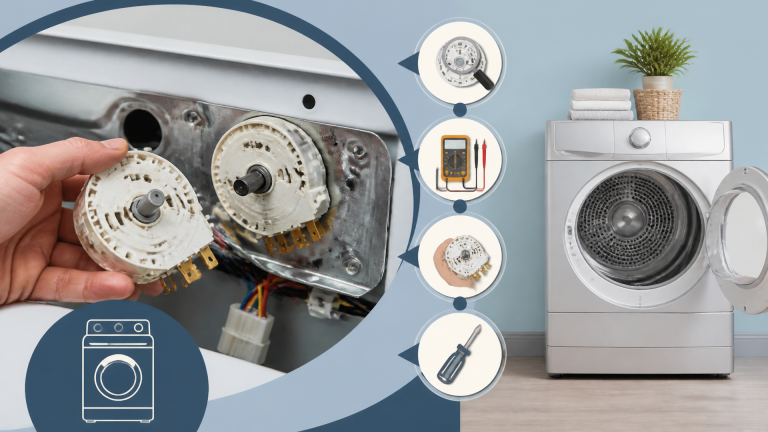
GE Dryer Not Starting: Causes and DIY Fix Guide
If your GE dryer won’t start, the most common causes are a faulty door switch, a blown thermal fuse, a defective start switch, or a tripped circuit breaker. Before calling a repair technician, you can safely diagnose and often fix the problem yourself using the steps below. The key is to identify whether the dryer makes any sound when you press start—a humming motor versus complete silence points to different issues.
First Things to Check Before Opening the Dryer
Start with the simplest checks that have the highest probability of a quick fix. These require no tools and take less than a minute.
- Power supply – Confirm the dryer is plugged in securely and the outlet is live. Reset the breaker at your panel (usually a 30‑amp double‑pole breaker) if it has tripped.
- Door latch – A misaligned or partially open door prevents the cycle from starting. Press the door firmly until you hear a click.
- Control settings – Make sure the timer dial is set to a timed‑dry or automatic cycle, not to a position like “off” or “air fluff.”
- Start button – Press and hold for 2–3 seconds. Some GE models require a sustained press. Listen for a relay click.
- Hum test – Press start and listen. A humming sound means the motor is trying to turn but cannot start (likely a seized motor, bad capacitor, or broken belt). No sound at all points to a power, switch, or fuse problem.
BLOCKQUOTE_0
Common Causes and How to Diagnose Each
Once the basic checks are done, move to component-level testing. You’ll need a multimeter set to continuity (Ω) mode. Unplug the dryer before any internal inspection.
Door Switch Failure
The door switch is the most frequent culprit. When the door closes, it presses a plunger that completes the circuit. If the switch is stuck or broken, the dryer thinks the door is open.
- Test – Remove the two wires from the switch (typically located behind the door catch). With the switch plunger pressed in, check for continuity. If there is no continuity when pressed, or continuity when released, replace the switch.
- Cost – A new switch costs about $5–$15 and takes 15 minutes to install.
Blown Thermal Fuse
The thermal fuse is a safety device that cuts power if the dryer overheats. It cannot be reset—once blown, it must be replaced.
- Location – Usually on the blower housing or exhaust duct near the back of the dryer.
- Test – Disconnect the wires and check continuity across the fuse. If the multimeter reads infinite resistance (no continuity), the fuse is blown.
- Root cause – A blown fuse often indicates restricted airflow (lint buildup in the vent). Clean the vent thoroughly before replacing the fuse, or the new fuse will blow again.
Defective Start Switch or Relay
On electronic‑control models, the start button triggers a small relay. If the button feels loose or the relay doesn’t click, the circuit may not close.
- Test – With the dryer unplugged, remove the start switch and check continuity when the button is pressed. For relay‑based systems, listen for a click when pressing start; a silent relay means the control board or relay is faulty.
- Trade‑off – Replacing a start switch is easy and cheap (under $10). A faulty control board can cost $100–$200 and may not be worth repairing on older dryers.
Belt Switch (on Some Models)
Many GE dryers include a belt switch that detects a broken drive belt. If the belt breaks, the switch opens and prevents the dryer from starting.
- Test – Locate the switch near the idler pulley. With the belt tensioned, the switch should be closed (continuity). If the belt is intact but the switch is faulty, you can replace both the belt and switch.
- Decision criterion – If the dryer hums but the drum does not turn, the belt is likely broken. If the dryer is completely silent, the belt switch may be the cause, but a belt failure alone usually allows the motor to run.
Motor Start Capacitor or Seized Motor
If the dryer hums loudly but the drum does not move, the motor’s start capacitor may be weak or the motor bearings may be seized.
- Capacitor test – Use a multimeter with capacitance function. A reading far below the rated value (printed on the capacitor) indicates replacement is needed. Capacitors cost $10–$20.
- Motor test – Remove the belt and try spinning the drum by hand. If the motor shaft is stuck, the motor is seized and must be replaced—often a $150–$250 job that may exceed the dryer’s value on units over 10 years old.
Step‑by‑Step DIY Fixes
Follow these steps in order. Each step builds on the previous one, so you don’t duplicate work. After each repair, verify the fix by running a complete cycle before moving on.
1. Verify power – Check the breaker and outlet with a multimeter (120V each leg to neutral, 240V between legs). If voltage is missing, call an electrician. Verification: Plug a known working lamp into the outlet; if it lights, power is present.
2. Test the door switch – Remove the top panel (two screws at the back, then lift and slide forward). Locate the switch, test as described, and replace if faulty. Verification: After replacement, reconnect power, close the door, and press start. The drum should begin turning immediately.
3. Check the thermal fuse – Access it from the back or bottom panel. Test continuity; replace if blown. Also clean the vent system. Verification: Run a short timed cycle and feel for strong airflow at the exhaust vent.
4. Test the start switch – On timer models, the switch is on the console. On electronic models, it may be part of the control board. Replace if defective. Verification: Pressing start should produce an audible click, and the dryer should run.
5. Inspect the belt and belt switch – If the drum is free but the belt is broken, install a new belt. If the belt is fine but the switch fails continuity, replace the switch. Before replacing the belt, consult our guide on how to fix ge dryer not spinning after belt replacement for proper tensioning steps. Verification: After belt replacement, the drum should rotate smoothly when pushed by hand, and the dryer should start without hesitation.
6. Evaluate the motor/capacitor – If all previous checks pass, remove the motor and test the capacitor. If the motor is seized, consider replacement cost versus buying a new dryer.
Decision Branch: What to Do When the Door Switch Passes
After testing the door switch and finding it has continuity, you’ll face a fork. If the thermal fuse is blown, replace it and clean the vent—that’s usually the fix. If the fuse is good, the next step is testing the start switch. If the start switch also passes, suspect a control board problem or a motor issue. This branching logic prevents you from replacing parts that are still functional.
Failure Mode: Replacing the Thermal Fuse Without Cleaning the Vent
A common mistake is assuming a blown thermal fuse is a one-time event. If you replace the fuse without addressing the underlying cause—usually a clogged vent—the new fuse will blow again within a few cycles. Symptom: the dryer runs briefly, then stops and won’t restart. The fix: after replacing the fuse, disconnect the exhaust duct from the back of the dryer and run a short cycle. You should feel a strong, steady airflow. If the airflow is weak, clean the entire vent run with a brush kit or replace the ducting.
When to Call a Professional
- You have no voltage at the outlet after checking the breaker.
- The thermal fuse has blown repeatedly even after cleaning the vent.
- The dryer makes a loud humming or grinding noise and the motor does not turn.
- You are uncomfortable working with electrical components or using a multimeter.
- The dryer is more than 12 years old and the repair estimate exceeds 50% of a new unit’s price.
In those cases, a licensed appliance technician can diagnose hidden issues such as a failing control board, shorted wiring, or a grounded motor. For a broader look at common issues, check our troubleshooting ge dryer common problems guide for additional symptoms and solutions.
Quick Diagnostic Checklist
Use this checklist to narrow down the cause before removing any panels. For each item, mark pass or fail.
| Check | Pass | Fail |
|---|---|---|
| Breaker not tripped, outlet has 240V | ✓ | ○ |
| Door latch clicks when closed | ✓ | ○ |
| Timer set to a valid cycle | ✓ | ○ |
| Start button produces a click sound when pressed | ✓ | ○ |
| Dryer makes a humming sound when start is pressed | ✓ (motor issue) | ○ (power/switch issue) |
If you have a clear pass on the first four items but a fail on the hum test, your problem is motor-related. If you have any fail in the first four, start with the corresponding component test.