
GE Dishwasher Error Codes: Complete Guide and DIY Fixes
Most GE dishwasher error codes trace back to the same few mechanical failures: a clogged drain, a faulty thermistor, or a stuck float switch. Codes E1, E4, and F8 often share a root cause rather than indicating three separate, unrelated problems. This guide groups error codes by the physical fix they actually need, so you can skip the guesswork and decide when it’s time to call a technician.
The Counter-Intuitive Truth: Error Codes Often Duplicate Each Other
Most online lists present every GE error code as a unique entry with its own diagnosis. In practice, many codes simply describe the same underlying fault from different sensor angles.
- E1 (Long Drain), F8 (Water Overfill), and F9 (Drain Time Out) can all stem from a blocked drain hose or a failing drain pump. The code changes based on which sensor times out first—not the actual defect.
- E4 (Water Temperature Error) and F7 (Heater Fault) both frequently point to a thermistor that has drifted out of spec or a burned wire at the heater harness. A $10 thermistor swap clears both codes in many cases.
- F2 (Float Switch Stuck) and F8 (Water Overfill) both involve the float switch assembly. If the float moves freely but the switch fails electrically, you get F2. If the float is physically jammed, you get F8.
This overlap means you can save time by addressing the most probable mechanical cause first, rather than chasing each code independently. A multimeter and a visual check of the sump area resolve the majority of these codes without replacing the control board.
Quick Error Code Reference Table
Use this table to match your code to the most common fix. If the first fix doesn’t clear the code, move to the grouped root-cause steps below.
| Error Code | Meaning | Most Common Fix |
|---|---|---|
| E1 | Dishwasher failed to drain within 6 minutes | Clean the drain filter and check for a kinked drain hose |
| E4 | Water temperature too low or too high | Replace the thermistor (part #WD21X10078) and check heater continuity |
| F8 | Water overfill detected | Inspect float switch for free movement; clean float chamber |
| F9 | Drain pump timeout | Clear debris from pump impeller and drain sump |
| F2 | Float switch stuck open | Manually lift and release float; replace switch if no resistance change |
Before You Start: Safety and Prep Checklist
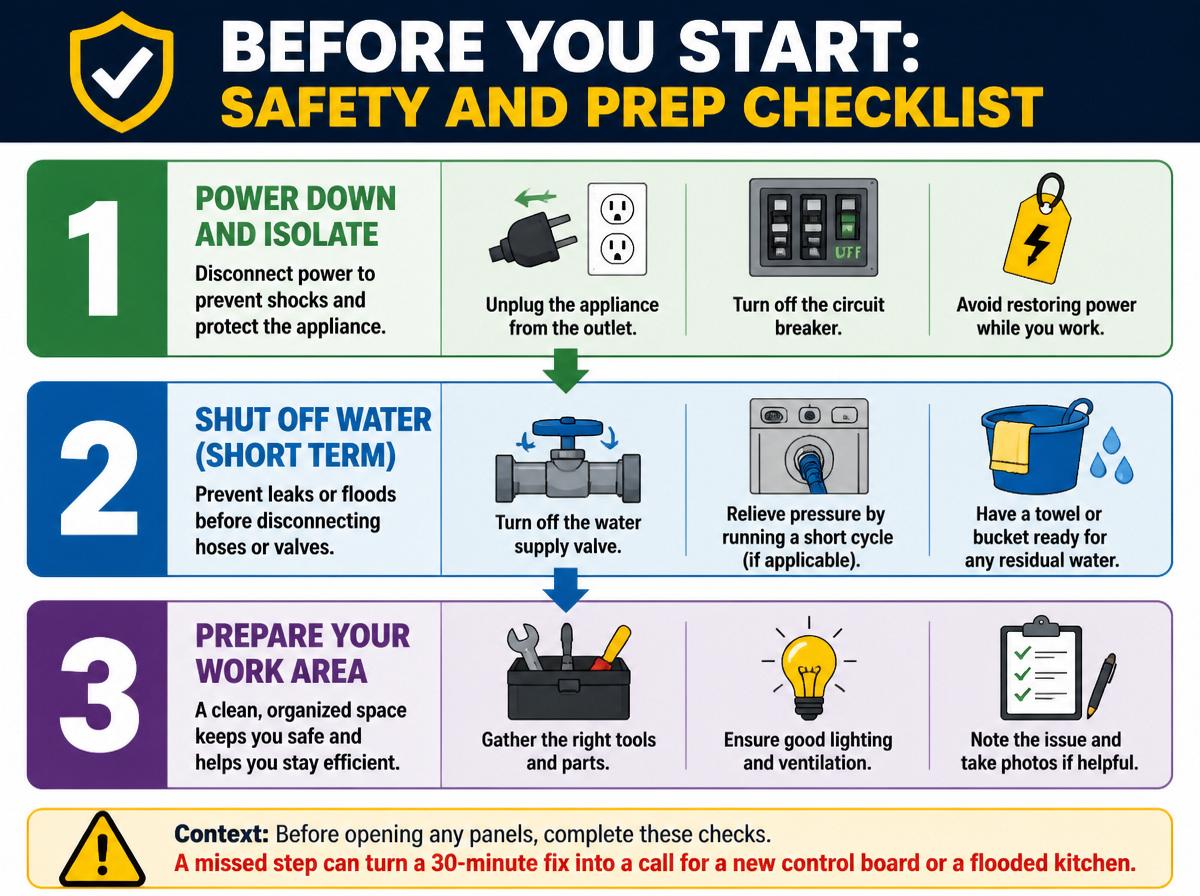
Before opening any panels, complete these checks. A missed step can turn a 30-minute fix into a call for a new control board or a flooded kitchen.
- [ ] Unplug the dishwasher or flip the circuit breaker OFF. Do not rely on the door switch alone—live voltage exists at the main harness even with a closed door.
- [ ] Place a towel under the front kickplate and have a shallow pan ready. Water will spill if you disconnect the sump hose.
- [ ] Verify the sediment trap at the bottom of the tub is empty. Many error codes clear after removing a broken glass fragment or a pasta skeleton that blocked the pump intake.
- [ ] Confirm the drain hose loop is at least 12 inches above the floor under the sink. A low loop allows sink water to backflow, causing false drain-timeout codes (E1 or F9).
- [ ] Have a multimeter capable of reading ohms (Ω). You do not need to test the main control board—only check thermistor resistance (approx. 50 kΩ at 70°F) and heater continuity (<20 Ω).
Step-by-Step DIY Fix Flow by Root Cause
Clogged Drain or Blocked Pump (E1, F9, sometimes F8)
- Remove the lower spray arm and sump cover. Use a Phillips screwdriver. Lift the cover straight up. Expect leftover water—tip the pan to catch it.
- Inspect the pump impeller. Rotate it by hand. If it resists or has a grinding noise, remove the pump assembly (two bolts) and clear any broken glass, toothpick, or bone fragment. Common mistake: assuming the pump motor is dead when it’s merely jammed.
- Clean the drain hose. Disconnect it from the sink tailpiece. Blow into the hose end—you should hear free airflow. If blocked, use a flexible brush or replace the hose (rubber hoses collapse over time).
- Run a drain test. Plug the dishwasher in, select Drain/Cancel, and listen for the pump hum. If no hum, test the pump motor with a multimeter (should read 10–30 Ω). If open, replace the pump.
- Success check: A normal drain cycle should empty the tub in under 2 minutes. If the cycle still times out, inspect the check valve near the sump outlet.
Branch point: what if the pump hums but water doesn’t move? Do not repeat the full drain test. Instead, check the drain hose for kinks or a collapsed section. A common mistake is re-cleaning the sump when the real blockage is a crushed hose under the cabinet. Failure mode: Even after clearing the hose, the code returns because a failed check valve lets water flow back into the tub. To verify, run a drain cycle and watch the hose end—if water gurgles back after the pump stops, replace the check valve.
Thermistor or Heater Failure (E4, F7)
- Locate the thermistor. It is a small plastic probe clipped to the side of the sump, near the heater element. Unplug the wire harness.
- Test resistance at room temperature. Touch multimeter leads to the two thermistor pins. Readings: ~50 kΩ at 70°F, ~10 kΩ at 120°F. If the reading is 0 Ω (short) or infinite (open), replace the thermistor immediately.
- If the thermistor tests okay, move to the heater element. Disconnect wires and measure across the heater terminals. A good heater reads 10–20 Ω. An infinite reading means the heater is burned open—replace it.
- Check for burnt wires at the harness connector. Corrosion or melted plastic around the heater plug is common on older GE models. Cut back and re-crimp if needed. Escalation signal: If both thermistor and heater are fine, the main control board may have a failed relay—do not attempt to repair the board yourself; replace it.
Verification step after replacing thermistor: Run a Normal cycle with a thermometer probe in a glass of water on the top rack. After the initial fill, the water should reach 120–140°F within 10 minutes. If the cycle throws E4 again, the new thermistor may be defective or the harness wiring is damaged inside the insulation. Failure mode: A poor connection at the thermistor harness can cause intermittent E4 codes. Use a multimeter to wiggle-test each wire while the dishwasher is off—resistance should stay stable; any jump indicates a break inside the wire.
Float Switch Stuck (F2, F8)
- Manually depress the float. It should move up and down with light finger pressure. If sticky, clean the float shaft with white vinegar and a toothbrush. Do not lubricate—oil attracts debris.
- Check the switch continuity. With the float down (normal position), the switch should be closed (0 Ω). With the float raised, it should open (infinite). If the switch fails to change state, replace the float switch assembly (typically $15–20).
- Inspect the float chamber for calcium deposits. Hard water buildup can lock the float halfway, causing a constant overfill code. Scrape deposits with a plastic tool. Stop point: If the float moves freely and the switch tests correctly but F8 persists, the control board misinterprets the signal—replace the board.
Branch point after cleaning: Turn the dishwasher on and start a rinse cycle. Watch the water level—it should stop filling about 1/2 inch below the float. If it fills past the float and triggers F8 again, the float switch is likely failing intermittently even though continuity looked fine at room temperature. Try pressing the float up and down 20 times to see if the switch becomes flaky. Failure mode: Some GE models use a float switch with a low current rating, and mineral deposits inside the switch housing can cause intermittent opens. Replacing the switch even when continuity seems okay is often the cheapest fix.
When to Stop Troubleshooting and Call a Technician
Some failures are best left to a professional, especially if you lack experience with electrical diagnostics. Stop DIY and escalate if any of the following apply:
- Water is pooling under the dishwasher after testing, indicating a cracked hose or sump seal that is not a simple clog.
- You have already replaced the thermistor, pump, and float switch, but the error code returns immediately after a reset. This points to a control board failure or a wiring harness fault.
- The error code is F4 (Short Circuit) or F6 (No Start). These often involve a defective main board or control panel overlay—neither is user-serviceable without an ESD-safe workspace.
- Any burned smell or visible scorch marks on the wiring. Stop immediately and unplug the unit. Call a licensed appliance repair technician.
For a deeper look at specific code combinations, see the guide on understanding the e4 f8 error code on your dishwasher. If you need a full walkthrough for disassembly and replacement, the step by step guide to fixing ge dishwashing machines covers each procedure with tool lists and torque specs. For a broader survey of recurring defects, consult the page on common issues with ge dishwashing machines.
In most cases, grouping error codes by physical symptom rather than by number lets you fix the dishwasher on the first pass. When a simple part swap doesn’t work, trust the escalation signals—spending an extra hour chasing a phantom code is far more expensive than a single service call.